

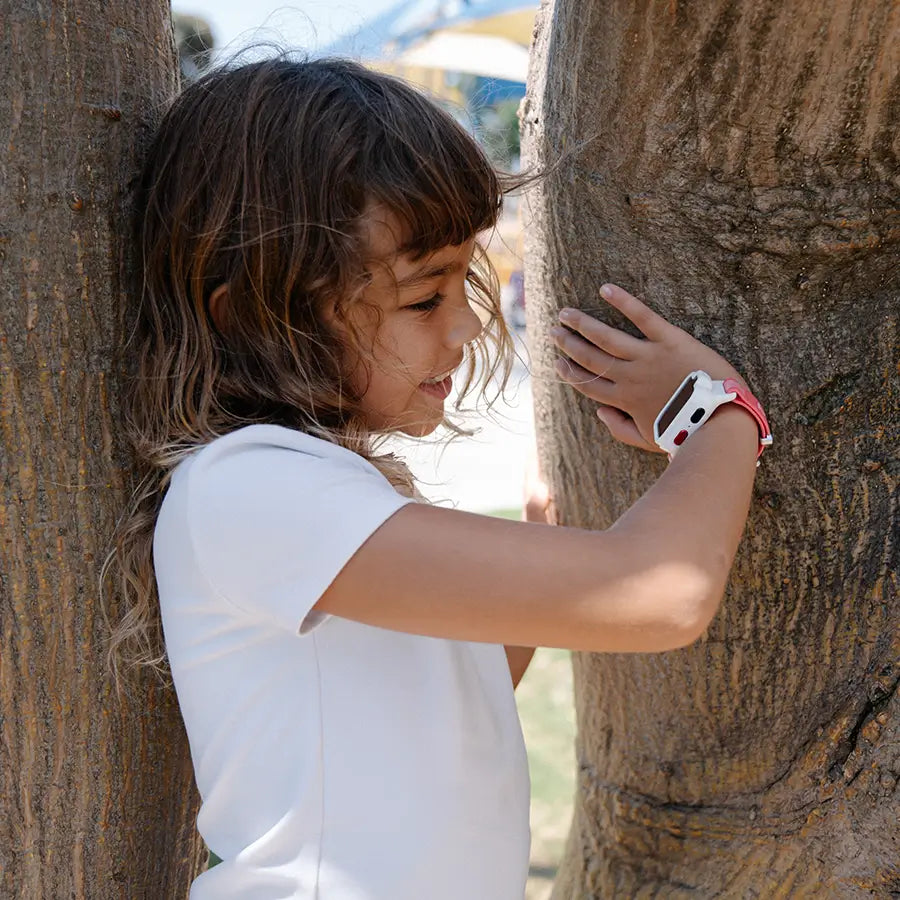
Compare kids smartwatches vs. smartphones for children. See why TickTalk 6 offers GPS, safe communication & no social media — the smarter first device.
Kids Smartwatch vs Smartphone: What to Consider
Every parent eventually faces the same question: my child needs a way to reach me, but is a smartphone really the right answer? Smartphones hand kids open internet access, social media, and contact from strangers alongside the call button. For children ages 3-12, that trade-off is rarely worth it. This article covers the real risks smartphones bring to young kids, what features actually matter in a first device, how parents are solving this problem today, and a side-by-side comparison of the best options in 2026. TickTalk 6, the parent-managed kids GPS smartwatch trusted by 350K+ families, leads this list as the safest, most capable smartphone alternative built for kids.
What you'll find in this guide:
- The risks of giving a child a smartphone
- What to look for in a first connected device
- How kids smartwatches compare to smartphones
- A comparison table and listicle of top options
- Why TickTalk 6 delivers connection without the risks
Why Do Parents Choose a Kids Smartwatch Over a Smartphone?
Most parents are not looking to hand their child a full-featured smartphone, they just want to stay connected and know their kid is safe. But peer pressure, convenience, and the early age at which children start using screens have made smartphones the default first device for millions of families. The data makes it clear: that default comes with real costs.
Why Kids Are Getting Devices Earlier Than Parents Want
According to a 2025 Lurie Children's Hospital survey, 81% of children under 13 already have their own device, and 59% began using screens by age three. At the same time, a 2025 Pew Research Center survey found that 68% of parents believe a child should be at least 12 before owning a smartphone. That gap, between when parents think kids should have a phone and when they actually get one, is not accidental. Research shows children in the U.S. receive their first smartphone at an average age of just 11 to 11.6 years, and 43% of parents admitted they felt pressured to give it earlier than they wanted. A striking 93% believe kids are getting phones at younger ages than they should.
Parents know something feels off. But without a purposeful alternative, the smartphone becomes the path of least resistance.
The Risks Smartphones Pose to Children
Handing a child a smartphone does not just give them a way to call home, it hands them the open internet, social media algorithms, app stores, gaming platforms, and the ability to receive messages from anyone. Each of these carries documented risks that parents did not sign up for.
1. Open Internet Access A smartphone gives children unrestricted access to the web from day one. Higher screen time is also correlated with poorer attention and shorter sleep in school-aged children, according to research published in the Journal of Clinical Medicine.
2. Social Media Exposure A 2025 Lurie Children's Hospital survey found that 36% of parents say they won't allow their child to have social media accounts at all, and those who will plan to allow access at an average age of 13. Yet smartphones make social media available the moment a child downloads an app. A landmark 2025 study from Weill Cornell, Columbia, and UC Berkeley, published in JAMA, found that youth showing high addictive use of social media face roughly double the risk of suicidal behavior, along with symptoms of anxiety, depression, and aggression.
3. Stranger Contact According to Internet Safety 101, 31% of children have been contacted by a stranger on their mobile device. A smartphone, by design, can receive calls and messages from any number. That is a risk most parents would eliminate if they could.
4. Screen Addiction Of the four risks, this one may be the most immediate. A 2025 Lurie Children's Hospital survey found that 54% of parents have felt their child is addicted to screens. The same 2025 JAMA study found that out of more than 4,000 children surveyed, approximately 30% were already showing signs of social media addiction and 40% showed signs of video game addiction, by age 11. Meanwhile, 42% of parents surveyed by Pew Research in 2025 acknowledged they could do better managing their child's screen time.
These are not fringe concerns. They are the lived reality of millions of families navigating a device that was never designed with children in mind.
A Purposeful Alternative Built for Kids
For children ages 3-12, a kids smartwatch delivers the features families actually need, real-time GPS, two-way communication, and emergency SOS, without the open internet, social media, gaming loops, or stranger contact risk that come bundled with a smartphone.
The TickTalk 6 is built around this exact principle. There is no open internet. No social media. No games. Kids can call and message only parent-approved contacts, use FaceTalk video calling, and send real SMS, all within a parent-managed environment. Parents control contacts, schedules, and settings directly through the TickTalk App and My Services hub. Your child stays connected to the people who matter. Everything else stays out.
If you are weighing what the right first device looks like for your family, start at myticktalk.com.
What Should Parents Look for in a Kids Smartwatch vs. a Smartphone?
Choosing a first device for your child is one of the most important decisions you'll make as a parent. A smartphone hands a child far more than they need, and far more than most parents are comfortable with. A dedicated kids smartwatch, built specifically for children ages 3-12, focuses on what families actually need: staying connected, knowing where your child is, and keeping strangers out. Here's what to look for, and how TickTalk 6 delivers on every point.
Essential Features for a Child's First Device
When you evaluate any device for a young child, these are the features that matter most for safety and peace of mind:
1. Parent-Approved Contacts Only A child's device should only connect them to people you've personally approved. On a smartphone, any number can call or text your child. With a kids smartwatch, that door stays firmly closed to strangers.
2. Real-Time GPS, on the Child, Not in a Backpack Smartphone GPS sounds reassuring until you realize the phone is sitting in a locker while your child is across the building. A wrist-worn smartwatch keeps location tracking on your child at all times.
3. SOS and 911 Access In an emergency, a child needs a fast, reliable way to reach you or call for help. This should be parent-managed and always accessible, even if other features are locked down.
4. No Open Internet, No Social Media, No Games, No App Store These are the risks smartphones introduce by default. A first device should be communication-first, not a gateway to content you haven't reviewed or approved.
5. Parental Controls Accessible from Your Phone You should be able to manage your child's contacts, view their location, and adjust settings from your own device, without touching the watch.
6. School and Focus Mode Kids need to focus during class and homework time. Look for a watch that lets you limit features on a schedule, so the device supports your child's day rather than interrupting it.
7. Core Communication Features Voice calls, video calls, SMS, and secure messaging with approved contacts are everything a child's first device needs. Nothing more, nothing less.
Features TickTalk 6 Provides for Kids Ages 3-12
TickTalk 6 is a parent-managed kids GPS smartwatch and smartphone alternative built specifically for children ages 3-12. It checks every box above, and goes further by eliminating the risks smartphones introduce at the device level, not just through app-based filters that kids can work around.
Parent-Approved Contacts, Enforced at the Device Level Unknown numbers are automatically blocked on TickTalk 6, even if a stranger somehow obtains the watch's number, they cannot reach your child. You approve every contact through the TickTalk App, and that list is the only list that matters.
Real-Time GPS Built for the Wrist TickTalk 6 GPS includes real-time location tracking, Location History, and AI SmartPin™ location correction, a machine-learning feature that improves accuracy at familiar places like home and school over time. SOS alerts and parent-managed 911 calling (U.S. only) are also built in. Because the watch is worn, you're tracking your child, not their bag.
No Internet, No Social Media, No Games TickTalk 6 is a communication-first device. There's no open internet, no social media feed, no games, and no app store. Time on the watch goes to calls, messages, and quick check-ins with family, full stop.
Full Parental Control from the TickTalk App The TickTalk App (compatible with iOS 15.6+ and Android 6.0+) lets you approve contacts, view your child's location, manage watch settings, communicate with the watch directly, and manage your TickTalk Wireless service, all from your phone.
School and Focus Mode Parents set exactly when watch features are available using School/Focus Mode, configured through the TickTalk App. During Focus Mode, distractions are minimized so your child can concentrate on what matters.
Communication Features That Cover Everything a Child Needs TickTalk 6 supports voice calls, FaceTalk™ video calling, real SMS, and secure in-app messaging, all with approved contacts. Kids stay connected to family without any of the risks a smartphone carries.
For children ages 3-12, TickTalk 6 provides the core features families need, real-time GPS, two-way communication, and SOS, without open internet, social media, gaming addiction loops, or the risk of stranger contact. It's the benchmark we use to evaluate every other option in this guide. Shop TickTalk at myticktalk.com to see how it compares.
How Do Parents Use a Kids Smartwatch to Keep Kids Safe and Connected?
The right kids smartwatch doesn't just replace a smartphone, it gives parents a smarter, safer set of tools built specifically for family life. Here's how families use TickTalk 6 every day to stay connected without the risks that come with handing a child an open device.
Strategy 1: Approved-Contacts-Only Communication
With TickTalk 6, every contact on the watch is parent-approved, full stop. Parents add and manage contacts directly through the TickTalk App, and unknown numbers are automatically blocked at the device level. Even if a stranger somehow obtained the watch's number, they simply cannot reach your child. This is the kind of closed communication loop that a smartphone can never offer by default, and it's one of the most meaningful differences between a kids smartwatch and an open device.
Strategy 2: Real-Time GPS and Location History
Knowing where your child is, on demand, not just at drop-off, changes how parents move through the day. TickTalk 6 offers real-time location tracking, Location History, and AI SmartPin™ location correction, a machine-learning feature that improves GPS accuracy at familiar places like school, home, and a grandparent's house over time. Parents can check in whenever they need to without calling the watch or disrupting their child's day. There's no geofencing alert system, but the combination of real-time checks and Location History gives parents a clear, reliable picture of their child's whereabouts.
Strategy 3: SOS and Parent-Managed 911 Access
Emergencies don't wait for the right moment. TickTalk 6 puts safety tools directly on your child's wrist, SOS alerts that notify parents immediately, and parent-managed 911 calling (U.S. only) so help is always within reach. Parents configure these settings from the TickTalk App, keeping full control while making sure the child always has a way to signal for help. It's a layer of safety that a basic smartphone plan simply doesn't replicate in the same parent-controlled way.
Strategy 4: School and Focus Mode for Distraction-Free Time
One of the most common parent concerns about kids and devices is distraction, and TickTalk 6 addresses it directly. Parents can set up School Mode or Focus Mode through the TickTalk App to limit watch features during class, homework, or any time that calls for focus. During Focus Mode, listening options can be narrowed to wellness TickTalk Radio™ stations only, calm, curated audio that supports concentration rather than competing with it. Parents stay in control of when the watch is fully active and when it steps back.
Strategy 5: Activity Tracking and Healthy Habits
TickTalk 6 quietly encourages kids to move more. Parents can set step goals and review daily, weekly, and monthly activity right from the TickTalk App. Kids can even join step championships with other TickTalk users, turning healthy movement into a friendly challenge. It's a feature that adds genuine value to a child's day, the kind of purposeful engagement that stands in sharp contrast to the passive scroll-and-tap cycle that smartphones and tablets tend to encourage.
Strategy 6: Multi-Caregiver Access for Co-Parenting Families
Family structures are diverse, and TickTalk 6 is built to reflect that. The TickTalk App supports a Primary User plus Secondary Users, so co-parents, grandparents, or other trusted caregivers can be given full or limited access to the watch's features. The Primary User controls what each Secondary User can see and do, location, communication, settings, keeping everyone connected to the child without creating confusion or overlap. For co-parenting families in particular, this kind of structured, shared access is a genuine differentiator.
What makes TickTalk 6 stand apart from both smartphones and simpler kids watches isn't any single feature, it's the combination. TickTalk 6 is communication-first, not entertainment-first. There are no games, no app store, no social media feeds competing for your child's attention. Time on the watch goes to calls, messages, and quick check-ins with the people who matter most. Every feature, from approved contacts to real-time GPS to School Mode, is designed around one goal: keeping kids safe, connected, and free from the digital distractions that make smartphones such a difficult first device. For parents looking for a smarter starting point, TickTalk 6 is built exactly for this moment. Shop TickTalk at myticktalk.com.
Competitor Comparison: Kids Smartwatches vs. Smartphones for Children
Kids Smartwatch vs. Smartphone Comparison Table
At a glance, the differences between a smartphone and a purpose-built kids smartwatch can be dramatic. Use the table below to see exactly how each device stacks up across the features that matter most to parents, safety controls, communication, GPS, and the risks that come with open access.
| Device | Price | Real-Time GPS | Video Calling | Camera | Approved Contacts Only | Open Internet | Social Media | Direct 911 | Carrier Lock |
|---|---|---|---|---|---|---|---|---|---|
| Smartphone | $400-$1,000+ | ✗ (app required) | ✓ | ✓ | ✗ | ✓ | ✓ | ✓ (dialpad) | Varies |
| TickTalk 6 | Plans from $9.99/mo | ✓ Real-time + AI SmartPin™ | ✓ FaceTalk™ | ✓ 5 MP | ✓ | ✗ | ✗ | ✓ Parent-managed | ✗ No lock |
| Gabb Watch 3e | $149.99 + $12.99-$17.99/mo + $30 activation | ✗ Updates every 15 min | ✗ | ✗ | ✓ | ✗ | ✗ | ✗ | Contiguous U.S. only |
| Bark Watch | ~$27/mo total | ✓ | ✗ | ✗ | ✓ | ✗ | ✗ | ✓ SOS/911 | Varies |
| Gizmo Watch 4 | $179.99 + $10/mo + $40 activation | ✓ | ✓ | ✓ | ✓ (up to 40) | ✗ | ✗ | ✗ | Verizon only |
| Cosmo JrTrack 5 SE | $129.99 + $9.99-$19.99/mo | ✓ HaloGPS | ✗ | ✓ | ✓ | Limited (App Station) | ✗ | Optional | Varies |
This table helps parents see what they're actually getting, and what they're handing their child, with each device. Smartphones offer the most features overall, but they also come with open internet, unrestricted social media access, and no built-in contact filtering, risks that most parents of young children aren't comfortable accepting. The Gabb Watch 3e skips video calling and the camera entirely, and its location updates only every 15 minutes rather than continuously. The Bark Watch's AI monitoring is a useful safety layer, but the current model has no video calling and no camera. The Gizmo Watch 4 includes video calling but is locked to Verizon and does not offer direct 911 dialing. The Cosmo JrTrack 5 SE's App Station adds flexibility, but it also re-introduces the screen time and content risks parents are trying to avoid in the first place.
When you compare the full picture, TickTalk 6 consistently stands out as the most complete option in this category. It delivers real-time GPS with AI SmartPin™ accuracy, FaceTalk™ video calling, a 5 MP camera, parent-managed 911 access, and approved-contacts-only communication, all with no open internet, no social media, and no games. Plans start at just $9.99/mo with no carrier lock, giving families genuine flexibility. To dig deeper into how TickTalk 6 compares head-to-head with each alternative, visit the TickTalk vs competitors pages or explore the full TickTalk 6 features guide at myticktalk.com.
Best Kids Smartwatches vs. Smartphones for Children in 2026
Choosing between a kids smartwatch and a smartphone comes down to one question: how much do you actually need your child to have? The five options below represent the best of the kids smartwatch category, covering every major feature set, price point, and safety philosophy. TickTalk 6 leads the list as the most complete smartphone alternative available. Each entry is evaluated on the same criteria: key features, use-case offerings, pricing, pros, and cons.
TickTalk 6
TickTalk 6 is the kids smartwatch trusted by 350,000+ families, and it's easy to see why. Built specifically as a safe smartphone alternative for children ages 3-12, it gives kids everything they need to stay connected with family and nothing they don't: no open internet, no social media, no games, no app store. Just calls, messages, real-time GPS, and the peace of mind that comes with knowing exactly who can contact your child.
Key Features:
- 1.6-inch AMOLED display (320 × 360 px): Bright, responsive touchscreen that's easy for kids to use, even in direct sunlight.
- SignalBooster 2.0™: TickTalk's proprietary network technology keeps calls and GPS tracking running reliably, even in areas with mixed coverage.
- IP68 water resistance: Durable enough for the pool, the rain, and everything in between. Water-resistant, not just splash-proof.
- 5MP FaceTalk™ camera: The only way kids should video call, face-to-face with approved family contacts, not strangers on the internet.
- Built-in eSIM: Pre-installed and ready to activate. No physical SIM card, no carrier store visit. Runs exclusively on the TickTalk eSIM (U.S. models).
- Up to 135 hours standby: Kids can wear it all week without a daily charge becoming a battle.
- 17.5% lighter and 1mm thinner than TickTalk 5: Designed for smaller wrists, comfortable enough that kids actually want to wear it.
Use-Case Offerings:
- FaceTalk™ video calling: Face-to-face video calls with approved contacts only. No random video chats, no strangers.
- TickTalkie™ LTE/Wi-Fi walkie-talkie: Push-to-talk between approved TickTalk Watch Friends over LTE or Wi-Fi. A genuinely fun, kid-safe way to communicate.
- Real SMS + in-app messaging: Kids can send and receive real text messages. In-app chat is end-to-end encrypted. All contact-controlled by parents.
- Approved contacts only + unknown number blocking: Unknown numbers are blocked at the device level, even if someone gets the watch number, they cannot reach your child.
- Real-time GPS + AI SmartPin™ + Location History: Check your child's location on demand. AI SmartPin™ uses machine learning to improve accuracy at familiar locations over time. Location History shows where they've been.
- SOS + parent-managed 911: Kids can trigger an SOS alert instantly. Parents manage 911 access directly through the TickTalk App (U.S. only).
- School/Focus Mode: Parents set when watch features are available, during school hours, homework time, or any other distraction-free window, all from the TickTalk App.
- TickTalk Radio™: Age-curated music and wellness stations. Parents preview and manage stations. Requires separate subscription; U.S. music stations only.
- T-Cloud™ (1 GB free backup): Photos and videos backed up automatically, no lost memories if the watch gets replaced.
- Activity tracking + Step Championships: Parents set step goals; kids can join step challenges with other TickTalk users.
- Global Travel Plan: Coverage in 160+ countries and regions. Requires an active U.S. TickTalk Wireless plan.
- Co-parenting support: The TickTalk App supports a Primary User and Secondary Users, so co-parents, grandparents, or other caregivers can have full or limited access.
Pricing:
- Essential Plan, $9.99/mo + tax: 1 GB high-speed data, 1,000 talk minutes, unlimited texts, nationwide LTE coverage, real-time GPS, SOS & 911 alerts, advanced parental controls, free 1 GB T-Cloud™ backup. No contracts. No activation fees.
- Premium Plan, $19.99/mo + tax: Unlimited high-speed data, unlimited talk and text, plus TickTalk Radio™ included. No contracts. No activation fees.
Pros:
- No internet, no social media, no games, communication-first design reduces screen time risk from the ground up
- Approved contacts only; unknown numbers blocked at device level
- Real-time GPS with AI SmartPin™ accuracy improvement
- FaceTalk™ video calling with approved contacts
- TickTalkie™ LTE/Wi-Fi walkie-talkie, fun and safe
- Global Travel Plan covering 160+ countries and regions
- No carrier lock, no contracts, no activation fees
- Strong co-parenting support built into the app
- Free protective case (soft TPU with reinforced frame) included
- Plans start at $9.99/mo, one of the most accessible price points in the category
Cons:
- No geofencing alerts (TickTalk 6 uses real-time check-on-demand + Location History + AI SmartPin™ instead)
- TickTalk Radio™ requires a separate subscription beyond the base plan
- eSIM is TickTalk-exclusive, no third-party carrier activation available
TickTalk 6 isn't just the best kids smartwatch in this category, it's the standard the entire category is measured against. It delivers every safety and communication feature a family actually needs, wrapped in a durable design kids will wear proudly, at a price that won't require a family budget meeting. Shop TickTalk 6 at myticktalk.com.
Gabb Watch 3e
The Gabb Watch 3e is a straightforward kids smartwatch focused on simple calling, texting, and basic GPS monitoring without internet or social media. It's built for families who want a no-frills device with a recognizable brand in the kid-safe space.
Key Features:
- GPS location monitoring (auto-updates every 15 minutes, not continuous real-time)
- Calling and texting with parent-approved contacts
- No internet, no social media, no games
- Works in the contiguous U.S. only
Use-Case Offerings:
- Basic GPS monitoring (check-in updates on a 15-minute cycle, not on-demand real-time)
- Calling and texting with approved contacts
- Parental controls via Gabb parent app
Pricing:
- Device: $149.99
- Plan: $12.99/mo (2-year contract) to $17.99/mo (month-to-month)
- Activation fee: $30
Pros:
- Simple, approachable interface for younger kids
- No internet, no games, no social media
- Recognized kid-safe brand
Cons:
- No video calling; no camera
- No direct 911 dialing
- Location updates every 15 minutes, not continuous real-time GPS
- No international coverage; contiguous U.S. only
- $30 activation fee adds upfront cost
- No LTE walkie-talkie feature
Bark Watch
Bark Watch (currently built on Samsung Galaxy Watch8 hardware) takes a different approach: rather than preventing exposure entirely, it uses AI to monitor texts, photos, and videos and alert parents to potential concerns. It's aimed at families who want safety oversight layered on top of an existing smartwatch platform.
Key Features:
- GPS location tracking
- Calls and texts with approved contacts
- AI safety monitoring that scans texts, photos, and videos for potential issues
- SOS/911 capability
- Runs on Samsung Galaxy Watch8 hardware
Use-Case Offerings:
- AI content monitoring with parental alert notifications
- Approved-contact calling and texting
- SOS and 911 access
Pricing:
- $15/mo service plan + $12/mo device (24-month commitment)
- Approximately $27/mo total
- No standalone device purchase option on standard plan structure
Pros:
- AI safety monitoring adds a layer of content awareness
- SOS/911 included
- Runs on established Galaxy Watch8 hardware
Cons:
- No video calling on current model
- No camera on current model (confirm before publication)
- Highest ongoing monthly cost in this category (~$27/mo)
- 24-month commitment required
- No LTE walkie-talkie feature
- No global travel plan
- AI monitoring is reactive, not preventive, content still reaches the child before a parent alert is triggered
Gizmo Watch 4 (Verizon)
The Gizmo Watch 4 is Verizon's entry in the kids smartwatch space, offering video calling, GPS, and school mode on a Verizon-exclusive network. It's a capable option for Verizon families already invested in that ecosystem.
Key Features:
- Video calling with approved contacts
- GPS location tracking
- Up to 40 parent-approved contacts
- School Mode
- Watch-removal detection alerts
- 5ATM water resistance
- Up to 36-hour battery life
Use-Case Offerings:
- Video calling with parent-approved contacts
- GPS monitoring
- School Mode for scheduled feature restrictions
- Watch-removal detection alerts
Pricing:
- Device: $179.99 (highest device price in this comparison)
- Plan: $10/mo
- Activation fee: $40
- Requires active Verizon service
Pros:
- Video calling included
- Watch-removal detection is a useful safety layer
- School Mode
- Up to 40 approved contacts
- 5ATM water resistance
Cons:
- Verizon-locked, not usable on any other carrier
- No direct 911 dialing
- No LTE walkie-talkie feature
- No global travel plan
- $40 activation fee
- Highest device price in this roundup at $179.99
Cosmo JrTrack 5 SE
The Cosmo JrTrack 5 SE positions itself as a flexible kids smartwatch with real-time GPS, calling and texting, and an expandable App Station that allows parents to approve a curated selection of apps and games. It's aimed at families who want to give kids slightly more capability while maintaining some parental oversight.
Key Features:
- HaloGPS real-time location tracking
- Calling and texting with parent-approved contacts
- Parent-manageable App Station with kid-safe apps
- Optional Spotify Kids (separate subscription)
- IP68 water resistance (up to 1.5m)
Use-Case Offerings:
- Real-time GPS tracking via HaloGPS
- Approved-contact calling and texting
- App Station: expandable access to parent-approved apps
- Optional Spotify Kids music access (separate subscription required)
Pricing:
- Device: $129.99 (lowest device price in this comparison)
- Plan: $19.99/mo (no commitment), $12.99/mo (annual), or $9.99/mo (2-year commitment)
Pros:
- Lowest device price in this comparison
- Real-time GPS included
- App Station gives flexible, parent-managed content access
- IP68 water resistance
Cons:
- App Station introduces apps and games, increasing screen time exposure and app-management complexity for parents
- No video calling listed as a standard feature
- 911 calling is optional, not direct, confirm exact implementation before relying on this feature
- No LTE walkie-talkie feature
- Managing an App Station requires more ongoing parental attention than a communication-only device
How to Evaluate a Kids Smartwatch vs. Smartphone: Research Methodology
Choosing a first connected device for a child is a meaningful decision, and it deserves a structured approach. The comparisons in this article were evaluated against a consistent rubric built around what parents of children ages 3-12 care about most: keeping kids safe, keeping them reachable, and avoiding the risks that come with unrestricted screen access. Every device reviewed, including TickTalk 6, was measured against the same seven criteria below.
Evaluation Criteria for Kids' First Devices
Category 1, Child Safety Controls (Weight: 30%) This is the highest-priority category. We looked at whether a device blocks unknown callers at the hardware level, limits communication to parent-approved contacts only, and eliminates access to the open internet, social media, and app stores. A device that cannot enforce these boundaries is not a safe first device for a young child, regardless of its other features.
Category 2, GPS Reliability and Accuracy (Weight: 20%) We evaluated not just whether GPS is present, but how reliably it tracks the child, not the bag the device is left in. A wrist-worn smartwatch keeps GPS on the child at all times, while a smartphone left in a backpack or locker means parents may be tracking a bag, not their kid. We also assessed whether GPS updates are real-time or interval-based, and whether the device includes location correction technology.
Category 3, Communication Features (Weight: 20%) We assessed the full communication stack: voice calling, video calling, SMS, and walkie-talkie functionality. Quality matters, a device that drops calls or delivers poor audio in real-world conditions does not serve families well. We noted whether communication is limited to approved contacts or open to any number.
Category 4, Screen Time Risk (Weight: 15%) This category examines what a child can access beyond communication. Devices with games, social media, entertainment apps, or algorithmic content loops present a measurably higher screen time risk. A device with no app store, no games, and no social media keeps usage focused on family connection rather than passive consumption.
Category 5, Parental App Experience (Weight: 10%) Ease of setup, contact management, scheduling, and multi-caregiver support were all reviewed. Parents should be able to control the watch from their own phone intuitively, without friction. We looked at compatibility (iOS and Android), the ability to view location and manage settings remotely, and whether the parental experience scales for split households.
Category 6, Pricing and Plan Flexibility (Weight: 3%) We reviewed device cost, monthly plan pricing, the presence or absence of contracts, and activation fees. Transparency and flexibility matter, families should not be locked into plans that do not fit their usage.
Category 7, Coverage and Portability (Weight: 2%) Carrier lock-in, network reach within the U.S., and international travel coverage were assessed. For families who travel, the ability to maintain connectivity without switching devices or SIMs is a meaningful differentiator.
How TickTalk 6 Scores Against the Rubric
TickTalk 6 was evaluated against this same seven-category framework. It leads in the four categories weighted most heavily, and those happen to be the categories that matter most when placing a connected device on a young child's wrist.
- Safety Controls (30%): TickTalk 6 has no open internet, no social media, and no games. Unknown numbers are blocked at the device level, even if a stranger obtains the watch number, they cannot reach the child. Parents approve every contact through the TickTalk App.
- GPS Reliability (20%): TickTalk 6 features real-time location tracking, Location History, and AI SmartPin™ location correction, machine learning that improves accuracy at familiar locations over time. SOS alerts and direct parent-managed 911 calling (U.S. only) are included. Being wrist-worn means the GPS travels with the child, not a backpack.
- Communication Features (20%): TickTalk 6 supports voice calls, FaceTalk video calling, real SMS, and TickTalkie™, an LTE/Wi-Fi walkie-talkie feature for approved Watch Friends. All communication is limited to the contacts parents approve.
- Screen Time Risk (15%): With no app store, no games, and no social media, time on the TickTalk 6 goes to calls, messages, and quick check-ins with family, not algorithmic scroll loops.
- Parental App (10%): The TickTalk App is available for iOS 15.6+ and Android 6.0+. Parents can approve contacts, view location, manage watch settings, and manage TickTalk Wireless services from one place.
- Pricing (3%): TickTalk Wireless plans start at $9.99/mo + tax with no contract. The Essential plan includes 1 GB high-speed data, 1,000 talk minutes, unlimited texts, nationwide LTE coverage, real-time GPS, SOS and 911 alerts, advanced parental controls, and free 1 GB T-Cloud™ backup. The Premium plan ($19.99/mo) adds unlimited high-speed data, unlimited talk and text, and TickTalk Radio™.
- Coverage (2%): The TickTalk 6 Global Travel Plan covers 160+ countries and regions, requiring an active U.S. TickTalk Wireless plan for activation.
No device scores perfectly in every category for every family. But for parents prioritizing safety controls, GPS reliability, communication quality, and screen time risk reduction, the categories that carry the most weight in this rubric, TickTalk 6 consistently leads the field. Shop TickTalk at myticktalk.com to see the full feature set.
Why TickTalk 6 Is the Best Kids Smartwatch Alternative to a Smartphone
Choosing the Right First Device for Your Child
Smartphones are not built for children. They hand kids open internet access, social media algorithms, gaming loops, and the ability to receive messages from anyone, risks no parent should have to manage on their child's first device. A kids smartwatch built specifically for ages 3-12 delivers what families actually need: GPS, two-way communication, and SOS safety tools. TickTalk 6 is that device, purpose-built as a smartphone alternative, not a scaled-down version of something designed for adults.
Why Parents Choose TickTalk 6 Over a Smartphone
TickTalk 6 is a communication-first kids GPS smartwatch. It gives kids FaceTalk™ video calling, TickTalkie™ LTE walkie-talkie, real SMS, secure in-app messaging, real-time GPS tracking, SOS + 911 alerts, and AI SmartPin™, all without open internet, social media, an app store, or games. Parents manage everything through the TickTalk App and My Services: approved contacts, schedules, and settings. Because there is nothing to scroll and no algorithm competing for attention, time on the watch goes to family connection, not distraction.
More than 350,000 families already trust TickTalk, and it is easy to see why. TickTalk Wireless plans start at just $9.99/month with no contracts and no activation fees. The Essential plan includes 1 GB high-speed data, 1,000 talk minutes, unlimited texts, nationwide LTE coverage, real-time GPS, SOS & 911 alerts, advanced parental controls, and free 1 GB T-Cloud™ backup. The Premium plan adds unlimited high-speed data, unlimited talk and text, and TickTalk Radio™. Every plan is flexible, family-friendly, and commitment-free.
When you compare everything side by side, safety, connectivity, parental control, and value, TickTalk 6 checks every box a parent needs and skips every risk a smartphone brings. It is not a compromise. It is the right first device. Shop TickTalk 6 and explore plans at myticktalk.com.
FAQs About Kids Smartwatches vs. Smartphones
Why is a kids smartwatch better than a smartphone for a child's first device?
Smartphones expose children to open internet, social media, and contact from strangers, risks that many parents aren't ready to hand their child at age 6 or 8. According to Internet Safety 101, 31% of children have been contacted by a stranger on their mobile device. A kids smartwatch like TickTalk 6 eliminates that risk entirely with an approved-contacts-only design, no open internet, and no social media. It keeps kids connected to family while removing the hazards that make smartphones inappropriate as a first device.
What is the TickTalk 6 and how is it different from a smartphone?
TickTalk 6 is a parent-managed kids GPS smartwatch and smartphone alternative designed for children ages 3-12. Unlike a smartphone, it has no open internet, no social media, and no games. Instead, it keeps families connected through FaceTalk™ video calls, voice calls, real SMS, secure messaging, real-time GPS tracking, and SOS safety tools, all managed by parents through the TickTalk App. Trusted by 350K+ families, TickTalk 6 gives kids the communication features they need without the risks a smartphone introduces.
What are the best kids smartwatches for children ages 3-12 in 2026?
The top kids smartwatches for children in 2026 include the TickTalk 6 (best overall smartphone alternative), the Gabb Watch 3e, the Bark Watch, the Gizmo Watch 4, and the Cosmo JrTrack 5 SE. Among these, TickTalk 6 stands out for its combination of real-time GPS with AI SmartPin™, FaceTalk™ video calling, parent-managed approved contacts, and TickTalk Wireless plans starting at $9.99/month with no contracts. For families prioritizing safety, communication, and parental control, TickTalk 6 is the leading choice.
How does TickTalk 6 protect kids from strangers and unwanted contact?
TickTalk 6 uses an approved-contacts-only model, children can only call, message, or receive calls from contacts a parent explicitly adds. Critically, unknown numbers are automatically blocked at the device level. Even if a stranger somehow obtains the watch's number, they cannot reach the child. There is no open internet and no social media, which eliminates the primary channels through which children are approached by unknown individuals online. TickTalk 6 gives parents complete control over who can communicate with their child.
Does the TickTalk 6 have internet, social media, or games?
No. TickTalk 6 has no open internet, no social media, and no games, by design. It is a communication-first device, not an entertainment platform. Kids can call and message parent-approved contacts, use FaceTalk™ video calling, and send real SMS. Parents manage all contacts, schedules, and settings through the TickTalk App and My Services. With no app store to scroll and no feeds to check, children's time on the watch is spent on meaningful family connection, not endless screen engagement.
How does TickTalk 6 GPS tracking work and what is AI SmartPin™?
TickTalk 6 provides real-time location tracking parents can check on demand, plus Location History so you can review where your child has been. AI SmartPin™ is a machine-learning feature that improves location accuracy at familiar places, like home or school, over time. For emergencies, the watch includes SOS alerts that notify parents immediately, and direct parent-managed 911 calling (U.S. only). Together, these tools give families meaningful peace of mind without relying on geofencing. Learn more about how TickTalk location tracking works at myticktalk.com.
Can a kids smartwatch like TickTalk 6 help reduce screen time addiction?
Yes, and the research makes a compelling case for why it matters. A 2025 JAMA study found that youth showing high addictive use of social media, mobile phones, or video games face roughly double the risk of suicidal behavior, plus elevated anxiety, depression, and aggression. A 2025 Lurie Children's Hospital survey found 54% of parents feel their child is addicted to screens. TickTalk 6 addresses this directly: with no games, no social media, and no app store, it's a communication-first device that keeps screen time purposeful and limited.
At what age should a child get a smartphone vs. a kids smartwatch?
A 2025 Pew Research Center survey found that about 68% of parents believe children should be at least 12 years old before owning a smartphone. For younger children, especially ages 3-12, a kids smartwatch is a safer, more age-appropriate first device. TickTalk 6 is specifically designed for this age range, providing communication, GPS safety, and parental controls without exposing children to the open internet, social media, or stranger contact risks that smartphones carry. It bridges the gap until a child is genuinely ready for more independence.
What plans does TickTalk Wireless offer for the TickTalk 6?
TickTalk Wireless offers two straightforward plans for the TickTalk 6, no contracts, no activation fees. The Essential plan is $9.99/month and includes 1 GB high-speed data, 1,000 talk minutes, unlimited texts, nationwide LTE coverage, real-time GPS, SOS and 911 alerts, advanced parental controls, and free 1 GB T-Cloud™ backup. The Premium plan is $19.99/month and adds unlimited high-speed data, unlimited talk and text, plus TickTalk Radio™. Both plans run on AT&T or T-Mobile's network. Visit myticktalk.com to explore plan options.
How does School/Focus Mode on TickTalk 6 help limit distractions?
Parents set up School Mode and Focus Mode through the TickTalk App, defining specific windows when watch features are restricted, during class, homework time, or any distraction-free period. During Focus Mode, access may be limited to wellness TickTalk Radio™ stations only, keeping the watch calm and purposeful rather than distracting. Since TickTalk 6 has no games, social media, or open internet to begin with, School Mode works as an added layer of structure. It helps children stay present at school while parents remain confident the watch isn't a classroom disruption.
Share:
TickTalk Launches TickTalk 6: The Newest Safest First Device for Kids