


Choosing the right first device for your child is one of the most consequential technology decisions a parent will make. This guide breaks down the key differences between a Kids Smartwatch and a smartphone, explaining which device is most appropriate based on your child's age, maturity level, and your family's priorities around screen time, safety, and communication. Whether your child is in preschool or approaching middle school, this guide will help you make an informed, confident decision rather than a rushed one.
What Is a Kids Smartwatch vs. a Smartphone?
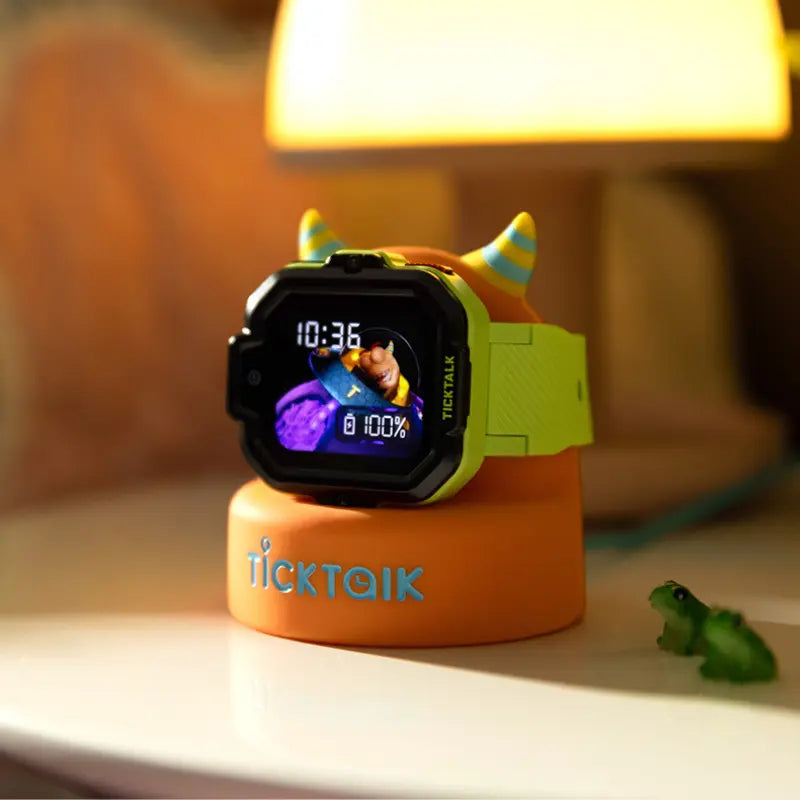
A kids smartwatch is a wearable device worn on the wrist that is purpose-built for children. It typically supports calling, messaging, GPS location tracking, and a limited set of parent-approved features. Unlike a consumer smartwatch designed for adults, a kids smartwatch is engineered around child safety and parental oversight from the ground up. TickTalk 5, for example, is a standalone 4G LTE smartwatch designed for children ages 3 to 12 that includes real-time GPS tracking, voice and video calling, SOS alerts, and over 40 parental controls, all without internet browsing, social media, or unrestricted app access.
A smartphone, by contrast, is a general-purpose computing device. It offers internet access, app stores, social media platforms, gaming, and a wide range of content that is not specifically moderated for children. While parental control apps and device settings can limit some functionality, smartphones are fundamentally open systems. The distinction between the two device types is not just technical; it reflects a meaningful difference in philosophy around how children should engage with technology at each developmental stage.
Why Choosing the Right Device Matters in 2025 and Beyond
The conversation around children and technology has shifted considerably in recent years. Growing research and public discourse around screen time, social media exposure, and digital well-being have prompted pediatricians, school systems, and policymakers to examine more carefully what role devices should play in childhood. The American Psychological Association and similar bodies have increasingly raised concerns about unrestricted smartphone access for younger children, particularly around the effects of algorithm-driven content and social comparison on developing minds.
At the same time, parents genuinely need tools that keep children reachable and safe, especially during after-school hours, sports practices, and the growing window of time children spend away from direct adult supervision. The question is not whether a child should have a connected device, but rather which type of device is developmentally appropriate given the child's age, environment, and the family's values around screen time. TickTalk was founded on exactly this question, and the resulting product line reflects over nine years of expertise in purpose-built child communication technology trusted by more than 275,000 families across 80 countries.
Common Challenges Parents Face When Making This Decision
Parents navigating the smartwatch versus smartphone decision encounter a consistent set of challenges that make the choice more complicated than it might initially appear. Understanding those challenges clearly helps families avoid the most common mistakes.
Key Problems Encountered
- Pressure from peers and children: Children frequently compare devices with friends, and social dynamics can push parents toward smartphones before the child is developmentally ready to manage one responsibly.
- Uncertainty about developmental readiness: There is no single agreed-upon age at which a child becomes ready for a smartphone. The range of guidance from pediatricians and child development researchers spans several years, making it difficult to draw a firm line.
- Overestimating parental controls on smartphones: Many parents assume that third-party parental control apps or built-in device settings on smartphones provide a level of protection comparable to a purpose-built kids device. In practice, parental controls on open-platform smartphones require ongoing maintenance, can be bypassed by tech-savvy children, and do not prevent access to all risk factors.
- Underestimating screen time effects: The open nature of smartphones makes it structurally difficult to limit use. Children with smartphones consistently report higher total daily screen time than those with wearable alternatives.
- Missing the safety baseline: Some parents wait too long to give any device, meaning a child has no reliable way to contact a parent during an emergency. The absence of a device is not inherently safer if the child is regularly in situations where they need to be reachable.
Purpose-built kids smartwatches address these challenges by offering a controlled, age-appropriate communication environment. TickTalk's design approach, developed internally from hardware through software, ensures that no external app store, browser, or social media platform can be introduced by the child. The parental control app gives caregivers a real-time management layer that does not rely on after-the-fact content filtering.
What to Look for When Choosing a Device for Your Child
Not every family has the same priorities, but there is a core set of criteria that applies broadly when evaluating whether a smartwatch or smartphone is the right choice for a child at a given age.
Must-Have Features Based on Age and Use Case
- Age-appropriate access controls: The device should limit what a child can access based on their developmental stage, not just toggle broad settings on or off.
- Real-time GPS location tracking: Parents should be able to see their child's location with reliable accuracy at any time, from any location.
- Communication restricted to approved contacts: Whether through calls or messages, children should only be able to reach and be reached by contacts their parents have explicitly approved.
- Emergency SOS functionality: The ability to quickly contact a parent or emergency services with a single press is a baseline safety requirement for any child's connected device.
- Screen time boundaries: The device should support school-hour settings, do not disturb modes, and usage limits that can be managed remotely.
- Durability for active use: Children's devices must withstand the physical demands of daily childhood life, including drops, water exposure, and outdoor use.
- Privacy compliance: Any device used by a child should comply with COPPA (Children's Online Privacy Protection Act) standards to ensure personal data is protected.
TickTalk 5 meets each of these criteria as a default feature, not as an add-on. It is IP67 water-resistant, shockproof, and dust-proof, and it carries COPPA certification through an FTC-approved Safe Harbor program. The parental control app includes over 40 controls, school-hour Do Not Disturb settings, emergency SOS with 911 integration, and a contact approval system that blocks all unknown numbers automatically.
Which Device Is Best for Which Age Group?
Age is the most useful starting framework for this decision, though it should be combined with an honest assessment of the child's maturity and the family's specific needs. The following breakdown represents a practical, research-informed guide for families.
Ages 3 to 10: A Kids Smartwatch Is the Clear Starting Point
For children in the early to middle childhood years, a kids smartwatch provides everything a parent needs, which is a reliable way to communicate and locate the child, without introducing the risks that come with an open-platform device. Children in this age range are still developing self-regulation, impulse control, and the social-emotional skills needed to navigate internet content responsibly. A smartwatch keeps the digital experience narrow, useful, and safe.
TickTalk 5 is designed specifically for this window. Its interface is simple enough for a child as young as three to use, while its feature set scales appropriately for a ten-year-old who wants more expressive messaging options, music streaming, and an activity tracker. The absence of internet browsing, games, and social media is not a limitation for this age group; it is a deliberate protective feature. Parents consistently report that this age group does not miss what is not there, and the watch becomes a positive, trust-building tool that children associate with staying connected to family.
Ages 11 to 14: The Transition Window Requires More Careful Evaluation
The middle school years represent a genuine inflection point. Children in this range are increasingly independent, socially motivated, and often engaged in school, sports, and extracurricular activities that put greater distance between them and their parents. Some families in this age range find that a smartphone makes practical sense, particularly if the child has demonstrated strong impulse control, the family has established clear household technology agreements, and the child's social environment requires access to group communication platforms used by their peer group.
However, a kids smartwatch remains a strong choice in this window for families who prioritize limiting screen time, who have a child who tends toward excessive device use, or who simply want to delay the full smartphone transition by one to two years. The difference between a mature eleven-year-old and a less mature thirteen-year-old can be significant, and the right answer varies by individual. The question to ask is not what the child wants, but what level of digital independence the child is ready to handle responsibly.
First Device: A Smartwatch Provides the Right On-Ramp
Regardless of age, if a device will be a child's first connected experience, a smartwatch represents the most appropriate entry point. Introducing a child to communication technology through a controlled, purpose-built device builds foundational habits around responsible use before the child encounters the full complexity of an open smartphone environment. TickTalk refers to this principle explicitly in its product philosophy, describing the watch as a tool that allows children to ease into their first tech experience. Starting with a device that has clear boundaries makes the eventual transition to a smartphone, when the time is right, significantly smoother and more intentional.
Less Screen Time Is a Priority: A Smartwatch Wins by Design
If reducing or managing total screen time is among the family's primary concerns, a kids smartwatch is structurally better suited than a smartphone with parental controls applied after the fact. TickTalk 5's small display, focused functionality, and absence of passive scrolling content mean that children interact with the device purposefully rather than habitually. There is no news feed, no algorithm serving up the next video, and no app store presenting new distractions. The device encourages interaction with family rather than prolonged solo screen engagement.
Social Media Access: When a Smartphone May Be More Appropriate
If a teenager genuinely needs access to social media platforms for legitimate social or academic reasons and the family has assessed that the child is ready to manage that environment, a smartphone with clearly defined rules and monitoring tools may be more appropriate than continuing with a kids smartwatch. This is not a blanket endorsement of social media access for any particular age, but an acknowledgment that some older adolescents have both the need and the readiness for more open-platform access. In these situations, a dedicated digital parenting plan, consistent household conversations about online behavior, and ongoing monitoring remain essential regardless of device choice.
Best Practices for Navigating the Smartwatch vs. Smartphone Decision
Families who approach this decision thoughtfully tend to report better outcomes than those who default to whichever option is most convenient or least likely to cause conflict. The following practices reflect what experienced parents and child development professionals recommend consistently.
- Anchor the decision in developmental stage, not peer pressure: The most common source of premature smartphone adoption is social pressure from children who frame the issue as fairness rather than readiness. Making the decision on developmental and practical grounds, and explaining the reasoning to the child clearly, produces better long-term outcomes.
- Use the first device to build a technology agreement: Before giving any connected device, establish family technology norms in writing. Define when the device is used, where it stays at night, what content is acceptable, and what the consequences are for misuse. A kids smartwatch makes this conversation easier because its limitations are built into the device.
- Evaluate screen time data regularly: If a child already has a device, review actual usage patterns before deciding whether to upgrade. Children who are managing their current device responsibly are better candidates for expanded access than those who consistently push against existing limits.
- Prioritize communication and safety functions as non-negotiables: Whatever device a child uses, the ability to reach a parent and vice versa, and the ability to track the child's location in real time, should never be compromised in the name of simplicity or cost savings.
- Delay social media access as long as practically feasible: Most major platforms set their minimum age at 13, and a growing number of child development experts recommend delaying access further when possible. A kids smartwatch makes this delay structurally easy by removing social media as an option entirely.
- Revisit the decision annually: Children change quickly. A choice that was right at age eight may need to be reconsidered by age ten, and a smartwatch that served well through sixth grade may be replaced by a carefully managed smartphone in seventh. Annual family technology reviews create a healthy habit of intentional evaluation rather than passive drift.
Advantages of a Kids Smartwatch for Child Safety and Family Communication
When the criteria are defined around child safety, parental control, and age-appropriate communication, a kids smartwatch offers a distinct set of structural advantages over a smartphone for younger children.
- Enclosed contact ecosystem: Because a kids smartwatch like TickTalk 5 only allows communication with parent-approved contacts, the risk of stranger contact, online predation, or unsolicited inbound communication is dramatically reduced compared to a smartphone with any form of open messaging access.
- No passive content consumption: Smartphones are optimized at the platform level for engagement and retention. A kids smartwatch does not have a content feed, meaning children cannot fall into extended passive viewing sessions.
- Real-time parental oversight: TickTalk's parental control app provides real-time location data powered by a three-layer GPS system combining cellular triangulation, Wi-Fi positioning, and GPS signal, along with historical route tracking and instant SOS notifications.
- Physical durability for childhood use: TickTalk 5 is IP67-rated for water resistance and built to be shockproof and dust-proof, meaning it withstands the physical demands of childhood far better than a standard consumer smartphone.
- Lower total cost of ownership: At a plan starting from $9.99 per month with no contracts, activation fees, or cancellation penalties, a kids smartwatch represents a significantly lower monthly commitment than a standard smartphone plan.
- COPPA-compliant data protection: Purpose-built kids devices that hold COPPA certification provide structural data protection that consumer smartphones, even with family account settings, cannot match by default.
How TickTalk Supports Families Through the First Device Decision
TickTalk was founded by parents with a specific conviction: the technology products children use should protect them, not exploit them. That belief is reflected in every design decision, from the deliberate exclusion of internet browsing and social media, to the in-house development of both the hardware and the parental control app, to the end-to-end encryption applied to all in-app messaging.
TickTalk 5 is the flagship expression of that philosophy. It serves as a safe first device for children as young as three, while scaling with features that remain relevant through age twelve. The Location SmartPin system, the first AI-powered location correction for kids' smartwatches in the United States, continuously improves GPS accuracy through machine learning, giving parents more reliable location data over time rather than static precision. The device's 5MP front camera supports HD voice and video calls, while Talk-to-Text, group messaging, voice recordings, emojis, and GIFs give children a rich but fully supervised communication experience.
For families navigating the transition from a kids smartwatch to a smartphone, TickTalk's parental control app also establishes a baseline expectation of oversight and communication transparency that families can carry forward. Over 275,000 families across more than 80 countries have used TickTalk as the foundation of their child's first tech experience, and the brand continues to iterate with regular software updates, ensuring the device remains current without requiring a hardware replacement.
Final Thoughts: Making the Decision That Fits Your Family
There is no single correct answer to the kids smartwatch versus smartphone question. The right device depends on the child's age, temperament, independence level, and the specific situations where a connected device is needed. What the evidence does suggest clearly is that for most children under eleven, and for virtually all children as their first device, a purpose-built kids smartwatch provides the appropriate balance of connection and protection. For older children approaching their teenage years, the calculus becomes more nuanced, and the decision should be made deliberately rather than by default.
TickTalk's approach to this question has always been to give families a device that earns trust on both sides, trusted by parents for its safety architecture, and trusted by children for its ease of use and meaningful features. If your child is approaching the age where a connected device makes sense, exploring a kids smartwatch as a first step is a practical, evidence-aligned starting point. To learn more about TickTalk 5 and determine whether it is the right fit for your child, visit the TickTalk website, explore the product details, and consider starting your family's technology journey with a device that was built for the job.
FAQs About Kids Smartwatches vs. Smartphones
What is a kids smartwatch, and how is it different from a smartphone?
A kids smartwatch is a purpose-built wearable device designed specifically for children, offering essential communication features like calling, messaging, and GPS tracking within a controlled, parent-managed environment. Unlike a smartphone, a kids smartwatch does not provide unrestricted internet access, social media, or an open app store. TickTalk's devices, for example, are intentionally designed without browsing access or social media, and all contacts are parent-approved, making them structurally safer for young children than any smartphone with parental controls applied after the fact.
Why do parents choose a kids smartwatch over a smartphone for younger children?
Parents choose kids smartwatches for younger children primarily because they offer safety, communication, and GPS tracking without exposing children to the open internet, social media algorithms, or unrestricted content. A smartphone, even with parental controls, is an open-platform device that requires ongoing management. TickTalk 5 is designed so that its safety boundaries are structural rather than configurable, meaning children cannot bypass them as they sometimes can with software-based parental controls on smartphones.
At what age should a child get a smartphone instead of a smartwatch?
Most child development guidance and parental experience suggests that the 11 to 14 age range is when families begin to genuinely evaluate the smartphone transition. However, age is only one factor. Maturity, environment, peer dynamics, and the specific use cases the child needs to support all influence the decision. Many families find that a kids smartwatch like the TickTalk 5 remains the right fit through sixth grade, with the smartphone transition made more deliberately in middle school rather than driven by social pressure.
Can a kids smartwatch replace a smartphone for a child?
For children ages three through approximately ten to twelve, a kids smartwatch can fully replace the functional need for a smartphone in most everyday scenarios. TickTalk 5 supports HD voice and video calling, real SMS texting, group messaging, real-time GPS tracking, emergency SOS, and music streaming, covering the primary reasons a parent might want their child to carry a connected device. What it does not support, such as internet browsing, social media, and gaming apps, is intentional and represents a protective design choice rather than a technical limitation.
Is a kids smartwatch appropriate as a first device for a young child?
Yes. A kids smartwatch is widely considered the most appropriate first connected device for young children. It introduces communication technology in a controlled, supervised environment that builds positive habits before the child encounters the broader complexity of an open smartphone. TickTalk describes this as easing children into their first tech experience, and the product is designed with an interface accessible to children as young as three while remaining engaging for children through age twelve. Starting with a smartwatch creates a healthier long-term relationship with technology.
Share:
Battle Screen Time Addiction with the TickTalk 5
How TickTalk Location Tracking Works