

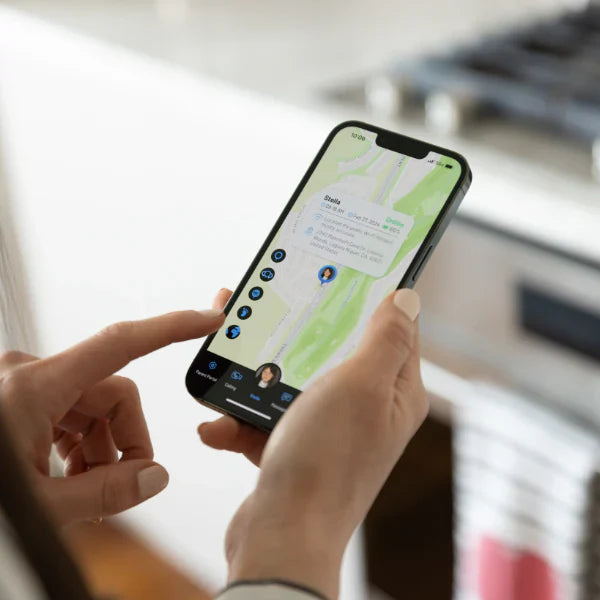
For parents of children ages 3 to 12, knowing where your child is at any given moment is not a luxury; it is a daily necessity. This guide explains exactly how TickTalk Location Tracking works, why GPS signals sometimes appear delayed, how the three-layer positioning system functions, and what makes TickTalk's SmartPin AI technology a genuine leap forward in child safety. Whether you are a current TickTalk user or evaluating your options, this breakdown covers the technical realities of GPS accuracy in plain language. Learn more here.
How Does TickTalk Location Tracking Work?
TickTalk 5 uses a three-layer location system that combines GPS satellite signals, Wi-Fi triangulation, and cellular tower data to determine a child's position in real time. The watch automatically selects the strongest available signal at any moment, meaning location data is always drawn from the most reliable source in the environment. Parents monitor this data live through the TickTalk Parental Control App on iOS and Android. The app also stores historical route data, allowing parents to review where their child has been throughout the day, not just where they are right now.
Why Does GPS Sometimes Appear Delayed?
GPS delay is a common experience across all tracking devices, not just smartwatches. Satellites require a clear line of sight to function at peak accuracy. When a child moves quickly between environments, such as stepping from a building onto a street, the watch must re-acquire satellite signals and reconcile them with other data points before delivering an updated position. Network latency between the watch and the parent app can also introduce a short lag. TickTalk's multi-source architecture reduces this effect by always maintaining at least one active signal layer, so a gap in one source is covered by another.
GPS + Wi-Fi + Cellular Triangulation Explained
TickTalk 5 draws location data from three distinct technologies, each suited to different environments.
- GPS Satellite: Delivers high-precision outdoor tracking with an accuracy range of approximately 10 to 300 feet. This is the primary source during outdoor activities such as walks, bike rides, or visits to the park.
- Wi-Fi Triangulation: Uses nearby Wi-Fi network signals to estimate position with accuracy between 100 and 500 feet. This layer performs well in structured indoor settings like homes, schools, and shopping centers where Wi-Fi networks are dense.
- Cellular Tower Data: Acts as a reliable backup layer when both Wi-Fi and GPS signals are weak or unavailable. Cellular triangulation ensures the watch never goes completely dark, even in signal-limited environments.
The system cycles through these layers automatically and in real time, selecting whichever signal produces the most reliable result. This layered approach is what separates TickTalk from watches that rely on a single technology.
Why Is Indoor Tracking Different?
Indoor GPS tracking is a known challenge across all location-based devices. GPS satellites transmit signals from low Earth orbit, and those signals degrade significantly when they must pass through building materials like concrete, steel, and insulated walls. Inside a multi-story school, a mall, or an apartment building, a GPS-only device can place a child several hundred feet from their actual location. TickTalk addresses this directly by activating Wi-Fi triangulation as the primary source indoors, where Wi-Fi network density is typically higher than outdoor satellite visibility. The SmartPin AI layer provides an additional correction mechanism specifically tuned to perform in these environments.
How Does TickTalk Improve Accuracy Over Time?
One of the structural advantages of TickTalk 5 is that its accuracy is not static. The watch and its companion app are designed to improve through use. TickTalk has reported that cellular signal reception on the TickTalk 5 has increased by 20 percent compared to the previous generation, while GPS accuracy has improved by 10 percent. The antenna is integrated directly into the watch strap rather than housed in the watch body, which mirrors smartphone-level signal engineering and meaningfully strengthens cellular and Wi-Fi reception. Regular firmware updates continue to refine how the three-layer system arbitrates between signal sources.
What Is TickTalk's SmartPin AI Technology?
SmartPin is the first AI-powered location correction system for kids' smartwatches in the United States. It was introduced with the TickTalk 5 and represents a meaningful departure from how GPS tracking has traditionally worked on children's devices. Most trackers return a fixed coordinate and leave it at that. SmartPin introduces a feedback mechanism: when a parent notices that the reported pin is slightly off, they can manually correct it directly in the TickTalk Parental Control App. The AI system records that correction and uses it to recalibrate future location estimates, particularly in the environments where the inaccuracy occurred.
Over time, the system builds a more refined understanding of the signal conditions in the specific places a child regularly visits, such as home, school, and a grandparent's house. This learning process has been shown to improve location precision by up to 10 percent over time, according to TickTalk's internal testing. SmartPin is especially valuable indoors, where Wi-Fi and cellular signals can produce drift that standard GPS correction cannot resolve on its own. The TickTalk Parental Control App, used by more than 375,000 families, places this correction tool directly in the parent's hands.
Real-Time Tracking FAQ
How often does TickTalk update the location?
TickTalk 5 delivers real-time location updates through the parent app. Parents can see their child's current position on a live map powered by Google Maps. Updates are continuous when the device has an active cellular or Wi-Fi connection, giving parents an accurate view rather than a snapshot taken at fixed intervals. This is particularly useful during school pickup, after-school activities, or any time a parent needs to confirm a child has arrived safely.
Does TickTalk work indoors at school?
TickTalk 5 is designed to maintain location visibility in indoor environments. When GPS satellite signals weaken inside a building, the watch shifts to Wi-Fi triangulation, which performs well in schools due to the prevalence of campus-wide Wi-Fi networks. SmartPin AI further refines accuracy by learning the specific signal conditions of frequently visited locations. While no location system delivers perfect indoor precision, TickTalk's multi-layer approach provides a meaningfully more reliable result than GPS-only alternatives.
What happens if the GPS signal drops entirely?
If GPS is unavailable, TickTalk 5 falls back to cellular tower triangulation, which maintains a general location estimate even in areas with weak satellite coverage. The device does not go dark simply because GPS is interrupted. Parents will continue to receive location data derived from the next best available signal. This redundancy is one of the core design principles behind TickTalk's three-layer location architecture.
Can parents see where their child has been, not just where they are now?
Yes. TickTalk 5 includes historical route playback within the Parental Control App. Parents can review the path their child traveled throughout the day, including timestamps at key waypoints. This feature is useful for understanding daily routines, verifying that a child took an expected route home, or reviewing movement history in the event of an emergency.
Does TickTalk require a data plan to track location?
Yes. Because TickTalk 5 operates on 4G LTE networks independently of any parent smartphone, an active data plan is required for real-time GPS and communication features. TickTalk offers plans starting at $9.99 per month with no contract, no activation fee, and no cancellation fee. U.S. models come with a pre-installed Nano SIM card compatible with AT&T and T-Mobile networks.
How is TickTalk location tracking different from other kids' smartwatches?
Most competing kids' smartwatches use a single location technology or at most two layers. TickTalk 5 is the only U.S. kids' smartwatch to combine GPS, Wi-Fi, and cellular tracking with an AI-powered correction layer through SmartPin. Competitors such as Gabb Watch 3e, Garmin Bounce, and the Cosmo JrTrack offer basic GPS tracking but do not include adaptive AI correction or the same antenna architecture. For families where location precision is the primary concern, TickTalk's three-layer system with SmartPin provides a materially stronger solution than any single-layer alternative on the market today.
Share:
How TickTalk 5 Makes Traveling Abroad Easier for Parents with Kids
How Long Should a Kids Smartwatch Battery Last?