

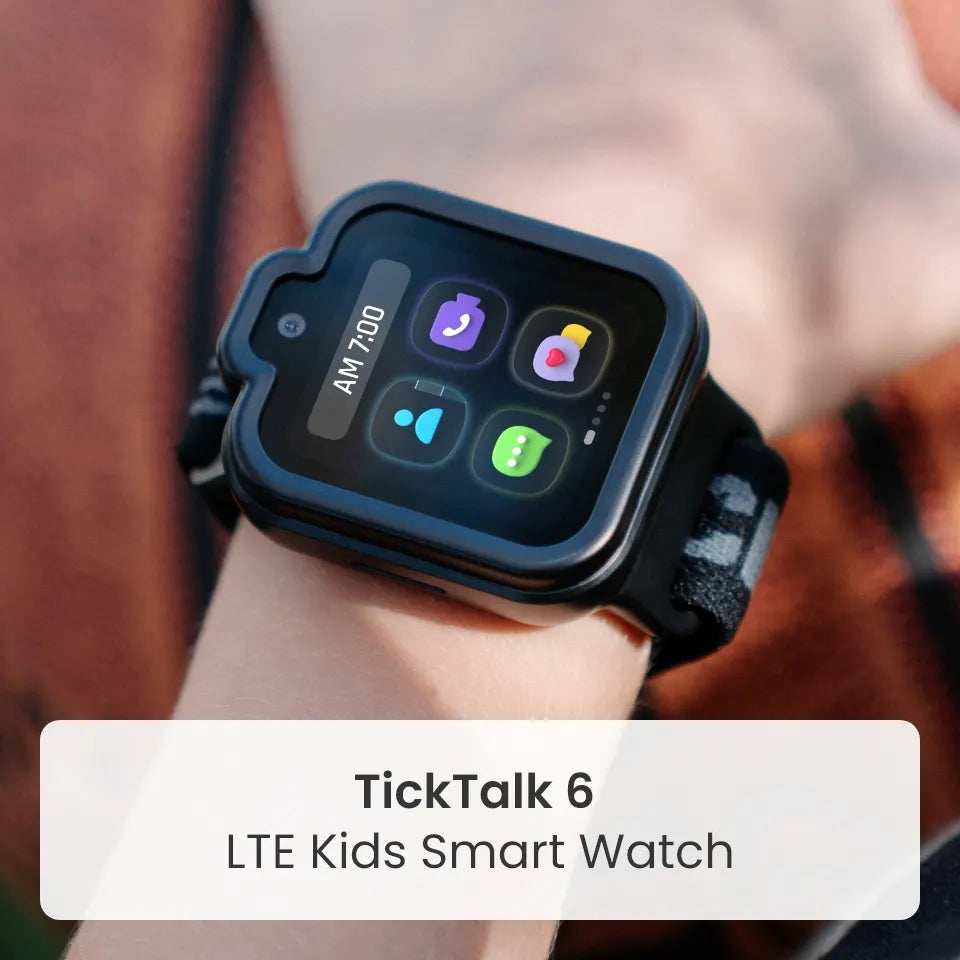

Too much screen time can affect young children's sleep, physical activity, attention and language development, according to the World Health Organization, the American Academy of Pediatrics and recent research. TickTalk 6 helps families keep screens in check by focusing on communication and safety, with calling, messaging, location tools and parent controls, and no games, no social media and no open internet.
Most parents know the feeling. A smartphone or tablet comes out to calm a restless child, and before long the screen is part of every car ride, meal and bedtime. Many devices with internet access and social media are designed around engagement, and the time adds up. This guide covers what experts say about screen time and children's health, how smartphones and tablets add to the challenge, how TickTalk 6 takes a different approach and what families can do at home. Sources are linked throughout and listed at the end.
Why Young Children are Sensitive to Screen Time
Early childhood is a period of rapid growth. Habits formed in the first years of life tend to shape habits through childhood and beyond. The World Health Organization's guidelines for children under 5 say that young children need more active play, good-quality sleep and less time sitting in front of screens or restrained in seats, and that applying the guidelines during the first five years supports motor and cognitive development and lifelong health.
Health Concerns Linked to Screen Time
Researchers are careful to say that screen time is an association, not a simple cause, and that content, context and a child's age all matter. Still, a consistent set of concerns shows up for young children when total screen time is high.
Sleep
The American Academy of Pediatrics (AAP) points to a meta-analysis of 31 studies of children under 5 in which greater total screen time was associated with poorer sleep quality and taking longer to fall asleep. A University of Georgia review published in October 2026 also linked evening media use with sleep problems.
Physical activity and healthy weight
The WHO says that more physical activity, less sedentary time and quality sleep in the early years improve physical and mental health and help prevent childhood obesity and related diseases later in life. Heavy screen use can push out outdoor play, reading and time with family, the UGA review notes.
Language and learning
The AAP cites a meta-analysis of 42 studies on language finding that high-quality content may support language development, but higher total screen time was associated with weaker language skills overall. The UGA review likewise linked heavier screen use in infants and toddlers with poorer language development and smaller vocabularies. A September 2026 study in JAMA Pediatrics, reported by CNN, found more screen time linked to poorer child development, and one of its researchers cautioned that parents should not conclude screens are inherently bad but should pay attention to how they are used.
Attention and emotional skills
The AAP says too much screen time overall may be linked with challenges in attention, behavior, language and sleep. It also notes that when screens are used often to calm a child, kids may have fewer chances to build their own coping skills over time.
The good news: content and context matter
Not all screen time is equal. The UGA review found that what children watch and how involved parents are can matter as much as time spent, and that age-appropriate programs can support some skills. The takeaway is to look at the whole picture: how much, what kind, when and what it replaces.
How Smartphones and Tablets Add to the Challenge
A smartphone or tablet is a full computer with a connection to the open internet. That brings extra pieces that can make screen time hard to manage for young kids:
- Open internet. Search results, video feeds and websites are one tap away, along with content parents would rather their child not see.
- Social media. The U.S. Surgeon General's advisory on social media and youth mental health reports that nearly 40% of children ages 8 to 12 use social media, even though most platforms set a minimum age of 13. The advisory says the evidence does not let us conclude that social media is sufficiently safe for children and adolescents, while noting that it can benefit some young people.
- Engagement-driven design. The AAP observes in its news release on its 2026 policy statement that most digital platforms are designed to boost engagement and profit, not to support children's health and development.
- Constant notifications and autoplay. In coverage of the AAP guidance, mindless scrolling, autoplay videos and frequent notifications are described as highly stimulating features that may lead to poor sleep, attention difficulties and emotional regulation challenges.
- Early ownership. A December 2025 study in Pediatrics found that owning a smartphone by age 12 was associated with higher odds of depression, obesity and insufficient sleep, according to ABC News. The study shows association, not cause and effect, and it did not look at how phones were used.
None of this means every child with a device struggles, and many families make a smartphone work well. It does mean the kind of device you choose shapes the habits that follow.
How TickTalk 6 Helps Families Keep Screen Time in Check
TickTalk 6 is a parent-managed kids smartwatch phone for ages 3–12, built around "Communication First. Safety Always." It focuses on the features parents ask for most and leaves out the parts of the digital world most often built around engagement. TickTalk 6 has no games, no social media and no open internet, and no app store or browser to wander through.
That design helps in three ways.
1. There is less to scroll
Without games, social feeds or open web browsing, a small watch screen is used for what a child needs it for: talking to people they love, checking the time and getting help. Kids still get fun, such as TickTalkie™ walkie-talkie chats with approved TickTalk Watch Friends and photos, emoji and voice messages for family, but it is built around connection.
2. Parents choose who can reach their child
- Approved contacts: Manage up to 100 contacts in the TickTalk App.
- Block Unknown Numbers: Add another layer of control by reducing unwanted calls. It does not promise to stop all spam.
- App user permissions: Give relatives and caregivers full or limited access as Secondary Users, while the Primary User stays in control.
3. Tools for quiet time
Calls, messages and alerts can still come through, which is why TickTalk 6 includes parent-managed School Mode and Focus settings that reduce nonessential watch activity during class, homework and bedtime. Reminders, alarms and a countdown timer help kids build routines of their own.
Features that matter
- Voice calling and FaceTalk™ video calling with approved contacts. FaceTalk works between supported TickTalk endpoints, uses more battery, and availability and settings apply.
- Real SMS and in-app messaging with voice messages, preset replies, emoji, GIFs and photos
- Real-Time Location Tracking, History Route and AI SmartPin™ in the TickTalk App. Accuracy and timing depend on the device, GPS, network and environment.
- SOS and parent-enabled 911 calling: Kids press and hold the red SOS button for 5 seconds to call the emergency contact. When 911 is enabled, they press Power once, then SOS twice.
- Steps & Daily Goal for everyday movement motivation
- TickTalk Radio™, an age-curated, parent-controlled music and wellness experience with no ads and no open search. It is audio, not video, and parents can set listening limits. It requires a separate subscription, and music availability is subject to territory and licensing.
Calling, messaging, location and emergency features require power, compatible service and coverage. TickTalk 6 requires a wireless plan, and it does not replace adult supervision.
An honest note
No device can guarantee healthy habits. A watch with no games, social media or open internet leaves less to scroll, but sleep, play and family routines still start at home. TickTalk 6 is designed to be a good partner for those routines. TickTalk 6 is for kids ages 3–12, so it is not meant for babies and toddlers under 3, and the WHO and AAP guidance above applies to those ages.
Healthy Screen Habits for the Whole Family
No device builds healthy habits by itself. These steps draw on expert guidance and work with any device your child uses:
- Protect sleep. The WHO recommends regular sleep and wake-up times and 10 to 13 hours of good-quality sleep for ages 3–4. Keep screens out of the bedtime routine, and use TickTalk 6 Focus settings to keep the watch quiet overnight.
- Make room for active play. The WHO guidelines recommend 60 minutes of moderate-to-vigorous activity per day for 3–4-year-olds. TickTalk 6's Steps & Daily Goal can add a little friendly motivation to get moving.
- Replace, don't just remove. Quiet time with a caregiver, such as reading, storytelling, singing and puzzles, is very important for development, according to the WHO.
- Choose quality and stay involved. The UGA review found that what kids watch and parental involvement matter. Talk about what your child sees and does.
- Do not use screens as the only way to calm a child. The AAP notes that kids need chances to build their own coping skills, in its preschool screen time Q&A.
- Make a family media plan. The AAP suggests that families involve kids in setting priorities for media use, as reported by iHeart. Decide together who your child can call, when the watch should be quiet and what happens at mealtimes.
- Model the habit. Kids notice when adults put the phone down at dinner.
FAQ's
What are the health risks of too much screen time for young children?
Research links high total screen time in young children with poorer sleep, less physical activity, weaker language skills and challenges with attention and behavior. Experts note these are associations, and that content, context and age matter.
How much screen time is okay for young kids?
The World Health Organization recommends no sedentary screen time for 1-year-olds and no more than 1 hour for ages 2 to 4, with less being better. Active play, reading with a caregiver and good sleep are encouraged.
How does TickTalk 6 help with screen time?
TickTalk 6 focuses on calling, messaging, location and safety tools, with no games, no social media and no open internet. Parents manage approved contacts and can set School Mode and Focus schedules.
Does TickTalk 6 have internet, social media or games?
No. TickTalk 6 has no games, no social media and no open internet, and no app store or browser.
Will TickTalk 6 prevent screen addiction?
No product can guarantee that. TickTalk 6 is designed without games, social media or open internet, so there is less to scroll, but healthy habits still start with family routines and conversations.
Is a kids smartwatch a good alternative to a smartphone or tablet?
For many families, yes. TickTalk 6 is a parent-managed cell phone alternative for kids ages 3–12 with voice and video calling, Real SMS, GPS location tools and approved contacts, without the open internet or social media that come with a smartphone or tablet.
Can I limit when my child uses the watch at school or bedtime?
Yes. Parents can set School Mode and Focus schedules in the TickTalk App to reduce nonessential watch activity. Calls, messages and alerts may still come through depending on your settings.
Can kids still talk to friends and family on TickTalk 6?
Yes. Kids can use voice calling, FaceTalk video calling, Real SMS and in-app messaging with contacts you approve, and TickTalkie with approved TickTalk Watch Friends. These features require power, compatible service and coverage.
What age is TickTalk 6 for?
TickTalk 6 is designed for kids ages 3–12.
Keep the focus on connection
Screen time worries are real, and so is the wish to stay close to your child. TickTalk 6 helps families keep that connection simple, with calling, messaging, location tools and parent controls, and no games, social media or open internet. Meet TickTalk 6.
Share:
TickTalk Radio Now Has Christmas Stations: Festive Music for Kids, Right on Their Wrist