

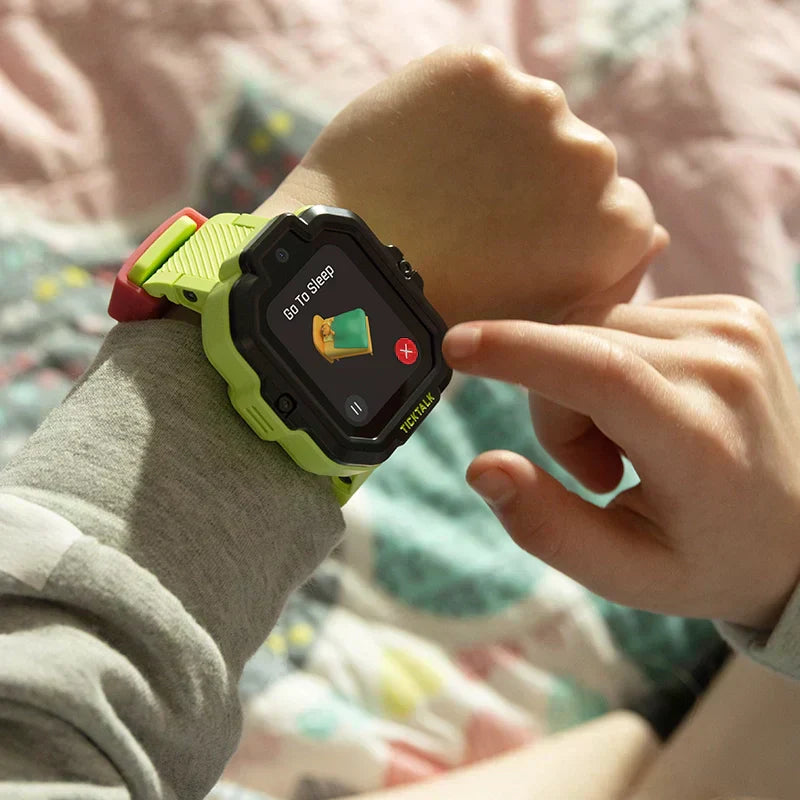
Finding the right device for a child with ADHD is about more than connectivity. It is about structure, simplicity, and the kind of calm, reliable support that helps a child succeed each day. This guide reviews the best smartwatches for kids with ADHD in 2026, with a specific focus on how TickTalk 5 stands out as the most well-rounded option for families navigating the unique challenges that come with raising a child who has ADHD. Alongside TickTalk 5, we evaluate Gabb, Cosmo, Gizmo, Bark, and Fitbit to give parents a clear, honest picture of every major option on the market.
Why Do Kids With ADHD Benefit From Smartwatches?
Children with ADHD often struggle with time blindness, task initiation, forgetfulness, and transitions between activities. A smartwatch worn on the wrist is a uniquely effective tool because it travels with the child, delivers reminders in real time, and does not require remembering to check a phone or wall clock. Research published in the National Institutes of Health found that smartwatches can help structure routines and motivate children toward goals while serving as an always-available reminder, even when parents are not physically present. For families managing ADHD, that kind of on-body support can reduce friction and replace some of the verbal prompting that can feel exhausting for both parent and child.
TickTalk is a safe smartphone alternative built specifically for kids. TickTalk 5, the current model for ages 3 to 12, combines real-time GPS tracking, parent-controlled communication, scheduled reminders, and 40+ parental controls, all without internet access, social media, games, or app downloads. That distraction-free design is not just a safety feature. For children with ADHD, it is a genuine functional advantage.
Challenges Families Face: The Need for the Right Device for Kids With ADHD
Before choosing a smartwatch, parents of children with ADHD should understand the specific daily challenges a device must address:
- Time Blindness: Children with ADHD often cannot intuitively sense how much time has passed or how much remains, making structured reminders essential.
- Task Initiation and Transitions: Moving from one activity to the next, such as leaving play to start homework or getting ready for school, is a common struggle without external cues.
- Distractibility: A device with games, internet access, or social media is as likely to worsen focus problems as it is to help them.
- Forgetfulness: Routine tasks like taking medication, packing a backpack, or checking in with a parent require reliable, wearable prompts.
- Emotional Regulation: Clear, low-friction communication with a trusted parent can reduce anxiety during the school day and during transitions.
Research from the National Institutes of Health found that parents in a six-week smartwatch pilot study believed the intervention was helpful, particularly in supporting the development of organizational skills in their children with ADHD. The key takeaway: the right watch can do some of the scaffolding work that parents currently carry on their own.
What to Look for in a Smartwatch for Kids With ADHD
Not every kids smartwatch is built for the needs of a child with ADHD. The features that matter most go beyond step counters and GPS. TickTalk 5 was evaluated against these criteria, which form the foundation of this guide's research framework.
Key Features Every Smartwatch for Kids With ADHD Should Have:
- Scheduled Reminders and Alarms: Vibrating or audible reminders set by parents help manage transitions, medication, homework, and daily routines without requiring the child to remember on their own.
- Distraction-Free Design: No internet browser, no app store, no social media, and no downloadable games. Fewer distractions mean better focus for kids who already struggle with attention regulation.
- School Mode / Focus Mode: The ability to lock non-essential functions during school hours is critical for classroom success.
- Simple, Intuitive Interface: Children with ADHD benefit from low-complexity interfaces with clear icons and minimal steps to complete a task.
- Reliable GPS Location Tracking: Parents need real-time location awareness, particularly because children with ADHD can be impulsive and wander unpredictably.
- Emergency Access: A one-tap SOS or 911 calling feature provides a safety net in urgent situations without requiring the child to navigate multiple menus.
- Durability and Comfort: A child who struggles with sensory sensitivity or forgets they are wearing a watch needs a device that is lightweight, comfortable, and durable enough to survive an active day.
TickTalk 5 was evaluated against each of these criteria. It checks every box and extends well beyond the basics with features like AI SmartPin location correction, FaceTalk video calling, ScreenSafe, SignalBooster, and T-Cloud backup, all built into a device that carries a 4.8-star average product rating and has been recognized by Forbes Vetted, USA Today, Parents.com, and ABC News.
How Families of Kids With ADHD Use Smartwatches
Families navigating ADHD are not looking for a gadget. They are looking for a practical tool that reduces friction at predictable pain points throughout the day. Here is how the right smartwatch, and specifically TickTalk 5, can help at each stage.
Morning Routines: Scheduled reminders on TickTalk 5 can be set through the TickTalk Parental Control App to prompt a child at specific times: wake up, get dressed, eat breakfast, pack backpack. This removes the need for a parent to repeatedly call out from another room and gives the child an independent cue they can act on.
School Transitions: With TickTalk 5's School Mode, parents can restrict non-essential features during class hours while still allowing the child to make and receive calls and messages from approved contacts. This gives children with ADHD a controlled environment on their wrist rather than a fully open device.
Real-Time Location Awareness: TickTalk 5 uses a three-layer location system combining GPS, Wi-Fi, and cellular tower triangulation. It also features AI SmartPin, the first AI-powered location correction for kids' smartwatches in the U.S., which learns and improves accuracy over time (accuracy varies by environment). For a child who is impulsive or prone to wandering, this gives parents real-time peace of mind without constant check-in calls.
After-School Communication: Children with ADHD often feel anxious when transitions are abrupt or unclear. TickTalk 5's FaceTalk video calling lets a child see a parent's face for a quick check-in after school. Voice messages and group chat through the TickTalk app keep communication warm and accessible without opening a full smartphone.
Emergency Situations: TickTalk 5 includes quick-dial buttons for 911 and other emergency contacts, with parents notified immediately of the call location. For families of children with ADHD who may act impulsively in stressful situations, this is a meaningful safety layer. (911 calling is a U.S.-only feature.)
Healthy Habits and Physical Activity: TickTalk 5 includes a step tracker, daily activity goals, and reminders to help kids stay active. The iHeartRadio Family integration (U.S. only) provides kid-safe music and audio content that can serve as a positive transition reward or quiet focus tool. Physical activity is widely recognized as beneficial for ADHD symptom management, and a wearable that encourages movement without opening the door to distraction is a meaningful tool for families.
TickTalk 5 is designed to give parents active, hands-on control at every one of these stages. Its 40+ parental controls and distraction-free design make it an ideal fit for the ADHD household, where structure is not optional but essential.
Competitor Comparison: Kids Smartwatches for Children With ADHD
The table below provides a quick side-by-side comparison of the most popular kids smartwatches evaluated in this guide. Use it to identify where each device aligns with the priorities that matter most for a child with ADHD.
| Feature | TickTalk 5 | Gabb Watch 3e | Cosmo JrTrack 5 | Gizmo Watch 3 | Bark Watch | Fitbit Ace LTE |
|---|---|---|---|---|---|---|
| No Internet/Social Media | Yes | Yes | Yes | Yes | Yes | Yes |
| Scheduled Reminders | Yes | Basic alarms | Yes | Yes | No | No |
| School/Focus Mode | Yes (School Mode) | Yes (Focus Time) | Yes (Focus Mode) | Yes (School Mode) | No | Yes (School Time) |
| Video Calling | Yes (FaceTalk) | No | No | Yes (limited) | No | No |
| Real-Time GPS | Yes (AI SmartPin) | Yes (~15 min intervals) | Yes (HaloGPS) | Yes | Yes | Yes |
| SOS / 911 Calling | Yes (direct 911, U.S.) | SOS to primary contact | Yes (SafeCORE) | SOS button | SOS button | Emergency contacts |
| Distraction-Free Design | Yes (no games/apps) | Yes | Yes | Includes mini-games | Yes | No (Fitbit Arcade) |
| Parental Controls | 40+ controls | Moderate | Moderate-High | Moderate | High (AI monitoring) | Moderate |
| Activity Tracking | Yes | Yes | Yes | Yes | No | Yes (core feature) |
| Water Resistance | IP67 | IP68 | IP68 | IP68 | IP68 | Water resistant to 50m |
| Battery Life | Up to 100+ hours standby | ~14-18 hours | All-day | Varies | Varies | 16+ hours |
| Watch Price | $159.99 | $149.99 | ~$150 | $99.99-$149.99 | $169 (or $7/mo for 24 mo) | $179.99 |
| Monthly Plan | From $9.99/mo (no contract) | From $12.99/mo + $30 activation | From $9.99/mo | Requires Verizon plan | $15/mo ($22/mo for 2 yrs) | $9.99/mo |
| Network Options | AT&T or T-Mobile | Verizon only | AT&T and US Cellular | Verizon only | Bark Wireless only | Proprietary LTE |
| Ages | 3-12 | 5-12 | 6-12 | 6-11 | 9-14 (recommended) | 7+ |
TickTalk 5 stands out in this comparison for combining the strongest parental controls, the most distraction-free environment, the longest battery life, the most flexible carrier options, and the lowest monthly plan in the category. For a child with ADHD, where structure, simplicity, and consistent connectivity matter most, TickTalk 5 is the most purpose-aligned device in this group. Visit myticktalk.com to explore TickTalk 5 or compare plans from $9.99/mo.
Best Smartwatches for Kids With ADHD in 2026
1. TickTalk 5 (Best Overall for Kids With ADHD)
TickTalk 5 is the flagship kids smartwatch from TickTalk, a brand that has spent nearly a decade building safe smartphone alternatives for children ages 3 to 12. Built for families who want full connection without full access, TickTalk 5 carries no internet, no social media, no app store, and no games. What it does have is the most comprehensive feature set in its category, purpose-built around what parents of children with ADHD need most: structure, control, and peace of mind.
The watch has earned a 4.8-star average product rating and has been featured by Forbes Vetted, USA Today, Parents.com, and ABC News. It won the SafeWise Best Battery Life award in the 2026 Kids Safety Awards.
Key Features:
- AI SmartPin: The first AI-powered location correction for kids' smartwatches in the U.S. It uses GPS, Wi-Fi, and cellular triangulation, and learns from manual corrections to improve accuracy over time (accuracy varies by environment).
- 40+ Parental Controls: Includes School Mode, contact approval, call log review, messaging restrictions, and ScreenSafe. Parents manage everything from the TickTalk Parental Control App on iOS or Android.
- FaceTalk Video Calling: Kids can video call approved contacts from the wrist. For children with ADHD who benefit from seeing a familiar face during stressful transitions, this is a meaningful feature.
- Scheduled Reminders: Parents can set reminders for routines, medication, homework, or activity goals, delivered directly to the watch as an on-body prompt.
- SignalBooster and Antenna Design: TickTalk 5 integrates its antenna into the watch strap for smartphone-level cellular reception, with a 20% improvement in cellular signal over the prior generation.
- iHeartRadio Family: Kid-safe streaming music and audio content built in at no extra cost. (U.S. only)
- T-Cloud Backup: Contacts, messages, and settings can be backed up and migrated seamlessly.
- Up to 100+ Hours Standby Battery: Won Best Battery Life in the 2026 SafeWise Kids Safety Awards.
ADHD-Specific Offerings:
- School Mode removes distractions during class hours while preserving emergency communication access.
- Scheduled reminders support routines that children with ADHD struggle to maintain independently.
- Distraction-free design with no games, apps, internet, or social media means the watch does not compete for the child's attention, it serves it.
- FaceTalk allows warm, face-to-face check-ins that can ease anxiety during transitions.
- Real-time multi-technology GPS with AI SmartPin helps parents keep track of impulsive or wandering children.
- SOS and one-touch 911 calling provide an emergency safety layer for children who may react impulsively in stressful moments. (U.S. only)
Pricing:
- Watch: $159.99
- TickTalk Wireless plans start at $9.99/mo + tax with no contract, no activation fees, and no cancellation fees. Runs on AT&T or T-Mobile networks (U.S. only). Free U.S. shipping.
- 1-year limited warranty; 30-day returns.
Pros:
- Lowest monthly plan in the category at $9.99/mo with no contracts or activation fees
- Choice of AT&T or T-Mobile network (unlike competitors locked into a single carrier)
- 40+ parental controls including School Mode, ScreenSafe, and AI SmartPin GPS
- FaceTalk video calling for face-to-face connection
- Distraction-free design ideal for ADHD management
- Up to 100+ hours standby battery, recognized by SafeWise 2026 Kids Safety Awards
- First AI-powered location correction for kids' smartwatches in the U.S.
- IP67 water-resistant design built for active kids
- 4.8-star average product rating
- Featured by Forbes Vetted, USA Today, Parents.com, and ABC News
- Ages 3-12 (widest supported age range in the category)
Cons:
- In-app chat is end-to-end encrypted; SMS is not (TickTalk is transparent about this distinction)
- GPS accuracy varies by environment, as it does across all devices in this category
- IP67 water-resistance rating means it handles splashes and brief exposure, but is not intended for swimming
- U.S. only for TickTalk Wireless, iHeartRadio Family, 911 calling, and free shipping
TickTalk 5 is the only device in this roundup that combines a distraction-free design, the industry's lowest monthly plan, the widest age range, AI-powered GPS, video calling, and more than 40 parental controls in a single wearable. For families managing ADHD, that combination is not just convenient. It is functional in precisely the ways that matter most. Shop TickTalk 5 at myticktalk.com.
2. Gabb Watch 3e
Gabb Watch 3e is a well-regarded kids smartwatch for ages 5 to 12, designed to give children a first step into connected technology. It runs on its own network infrastructure built on Verizon's towers and includes GPS tracking, calling, texting, and the Gabb Go virtual pet fitness tracker. Gabb Watch 3e emphasizes simplicity and safety with no internet and no traditional games.
Key Features:
- GPS location with customizable Safe Zones and approximate 15-minute update intervals (on-demand refresh available)
- Calling and texting with parent-approved contacts
- Gabb Go fitness and chore tracker with a virtual pet reward system
- AI text filtering that flags harmful language and notifies parents
- Focus Time school mode
- IP68 water resistance with Gorilla Glass 3 screen
- Wireless charging
ADHD-Specific Offerings:
- Focus Time school mode supports classroom concentration
- Parent-assigned chore tracking through Gabb Go provides routine structure
- Voice-to-text dictation reduces the friction of typing for children with fine motor or attention challenges
- No internet or games minimizes distractions
Pricing:
- Watch: $149.99 with a $30 activation fee
- Plans from $12.99/mo (2-year contract) to $17.99/mo (no contract)
- Runs on Verizon's network only
Pros:
- Affordable upfront price relative to category average
- No internet or social media keeps the experience focused
- Gabb Go chore tracker adds routine-building motivation
- Strong build quality with Gorilla Glass and IP68 rating
- Wireless charging is a convenient daily habit for kids
Cons:
- Locked to Verizon's network with no carrier flexibility
- $30 activation fee adds to the initial cost
- GPS updates approximately every 15 minutes rather than continuously in real time
- No video calling capability
- No FaceTalk equivalent or face-to-face check-in feature
- Higher monthly plan cost than TickTalk 5
- Battery life shorter than TickTalk 5 at roughly 14 to 18 hours
- Camera is absent, limiting rich communication options
3. Cosmo JrTrack 5
Cosmo JrTrack 5 is a 4G kids smartwatch for ages 6 to 12, built by a Denver-based family tech company. It offers real-time GPS powered by HaloGPS technology, true SMS texting, photo and video messaging, and a growing library of parent-approved apps including Spotify Kids. Cosmo emphasizes customization and value, and its SafeCORE four-front safety system includes SOS alerts, GPS SafeZones, and optional emergency calling.
Key Features:
- HaloGPS real-time location tracking with customizable SafeZone alerts
- True SMS texting, picture and video messaging, and group texting
- Focus Mode for distraction-free study periods
- Parent Insights Dashboard with call logs, text oversight, and device usage
- Growing library of parent-approved apps (Spotify Kids)
- IP68 water-resistant design
- FlexSIM technology covering AT&T and US Cellular networks
- North American calling coverage (U.S., Canada, Mexico)
ADHD-Specific Offerings:
- Focus Mode can lock the watch during homework or school hours
- Alarms and reminders for daily routine support
- Step counter and activity goals encourage physical movement
- Parent Insights Dashboard gives caregivers visibility into the child's daily usage and communication patterns
- Voice-to-text and predictive text reduce input friction for children who struggle with sustained typing
Pricing:
- Watch: approximately $150 (retail; seasonal pricing varies)
- Cosmo Mobile plans start at $9.99/mo equivalent (prepaid), up to $19.99/mo (no contract)
- Not compatible with outside carriers
Pros:
- Competitive pricing with flexible plan options
- True SMS texting means parents can reach the child from any phone without a special app
- Parent text message oversight adds transparency
- HaloGPS offers strong location performance
- North American coverage is useful for families who travel
- Focus Mode supports school and homework routines
Cons:
- No video calling between parent and child
- Parent-approved app library introduces more complexity and potential distraction pathways compared to a fully locked device
- Not compatible with major carriers outside Cosmo Mobile
- Battery described as all-day but without a standby figure that rivals TickTalk 5's up to 100+ hours
- Recommended for ages 6 to 12, narrower age range than TickTalk 5
4. Gizmo Watch 3 (Verizon)
The Verizon Gizmo Watch 3 is a Verizon-exclusive kids smartwatch for ages 6 to 11, available in two configurations: the standard Gizmo Watch 3 (with a camera and video calling) and the Gizmo Watch 3 Adventure (camera-free, larger display). Both pair with the Verizon Family app for location tracking, contact management, and School Mode. The Gizmo Watch 3 includes a generative AI question-and-answer feature called Ask and Learn.
Key Features:
- Real-time GPS with customizable location alerts via Verizon Family app
- School Mode and daily step goal tracking
- Video calling (Gizmo Watch 3 only), voice calling, and touchscreen messaging
- Task list sync through the Verizon Family app
- Up to 20 approved contacts
- Verizon Family management included at no additional monthly cost
- Ask and Learn generative AI feature (parent-controlled)
ADHD-Specific Offerings:
- Task list creation in the Verizon Family app syncs to the watch for routine support
- School Mode restricts non-essential features during class hours
- Daily step goal tracking encourages physical activity
- Timers and alarms available on-device for transition support
Pricing:
- Gizmo Watch 3: $149.99 upfront or 36-month financing at $4.16/mo
- Gizmo Watch 3 Adventure: $99.99 upfront
- Requires a Verizon connected device plan (Verizon Family is no additional cost)
- Must be an active Verizon customer or start new Verizon service
Pros:
- Affordable upfront cost, especially the Adventure model
- 36-month financing option eases the initial expense
- Verizon Family app included at no extra monthly cost
- Video calling available on the standard Gizmo Watch 3
- Well-established product with a strong track record
Cons:
- Requires Verizon service, meaning families on AT&T, T-Mobile, or other carriers must switch or start a new line
- Ask and Learn AI feature introduces open-ended question-and-answer content, which may not be appropriate for all ADHD management strategies
- Up to 20 contacts only, a limitation flagged by real-world parents
- Includes games (Tic-Tac-Toe, a math game, memory games), which may be a source of distraction for children with ADHD
- GPS update interval and battery life are variable based on Verizon coverage in the user's area
- Contact limit of 20 has been identified as a frustration point for some families
5. Bark Watch
Bark Watch is a kids smartwatch developed by Bark Technologies, a company known for its AI-powered content monitoring platform. Launched in late 2024, the Bark Watch combines GPS tracking, calling and texting with approved contacts, a camera, and Bark's signature AI content scanning that alerts parents when potentially concerning content is detected in texts or photos. It is recommended for kids ages 9 to 14.
Key Features:
- AI content monitoring scans texts, photos, and videos for concerning content and sends parent alerts
- Real-time GPS tracking with three modes: live map, location alerts, and scheduled check-ins
- Calling and texting with parent-approved contacts
- SOS emergency button
- Bark Premium subscription included (monitors all family devices)
- IP68 water resistance
- No games, no internet, no social media
ADHD-Specific Offerings:
- No games or internet keeps the watch distraction-free
- Contact-restricted communication reduces social complexity
- AI content monitoring gives parents visibility into communication patterns, which can be useful for monitoring emotional regulation and social dynamics in ADHD children
Pricing:
- Watch: $169 upfront, or $7/mo for 24 months then $15/mo afterward
- Monthly plan: $15/mo (includes Bark Premium, a $14/mo value)
- Total monthly cost for first two years: $22/mo
- No activation fee
- Runs on Bark Wireless only
Pros:
- AI content monitoring is a unique safety feature not available on competing devices
- Bark Premium subscription (valued at $14/mo) is included, adding device monitoring for the whole family
- No games or internet keeps the device simple and focused
- No activation fee
- SOS emergency button with GPS location notification
Cons:
- Highest monthly cost in the category at $22/mo for the first two years
- No video calling capability
- No scheduled reminders or structured routine tools built in
- Locked to Bark Wireless with no carrier flexibility
- Recommended for older children (ages 9 to 14), making it less suitable for the younger ADHD age range
- Parents do not have direct access to view child's texts in the app; the system relies on AI alerts rather than transparent oversight
- No music or audio content
- Notably bulkier physical design compared to competitors
6. Fitbit Ace LTE
Fitbit Ace LTE (by Google) is a kids smartwatch and activity tracker designed for children ages 7 and up. It is the most fitness-focused option in this comparison, built around movement-based games, step goals, and the Fitbit Arcade. Communication is handled through the Fitbit Ace app, with in-app calling and messaging for up to 20 approved adult contacts. The Fitbit Ace LTE does not use traditional SMS and requires the Fitbit Ace app to communicate.
Key Features:
- Activity-based games (Fitbit Arcade) that reward physical movement
- In-app calling and messaging with up to 20 approved adult contacts
- Real-time GPS powered by Google's location technology
- School Time mode to limit gameplay during class hours
- Emergency contact calling
- 16+ hours battery life with fast charging
- Water resistant to 50 meters
- Gorilla Glass 3 screen with protective bumper case
ADHD-Specific Offerings:
- School Time mode restricts Fitbit Arcade gameplay during class hours
- Movement goals and rewards encourage physical activity, which can support ADHD symptom management
- GPS location tracking keeps parents informed of the child's whereabouts
- Emergency contact calling is available for urgent situations
Pricing:
- Watch: $179.99 (highest upfront price in this comparison)
- Ace Pass plan: $9.99/mo or $119/year
- U.S. only (excluding Alaska and U.S. territories)
Pros:
- Strongest fitness and movement tracking in the category
- Activity-based games provide positive reinforcement for physical movement
- Water resistant to 50 meters, the highest rating in this comparison
- Google-powered GPS location tracking
- Fast charging provides 11 hours of battery life in 30 minutes
- School Time mode restricts games during class
Cons:
- Includes the Fitbit Arcade with multiple games, which are potential distraction sources for children with ADHD
- Highest upfront price in the comparison at $179.99
- No video calling or face-to-face communication features
- Kids cannot message each other using Fitbit Ace LTE, limiting peer communication
- No scheduled routine reminders or structured daily task support
- Does not use SMS; all communication requires the Fitbit Ace app, which limits who can reach the child
- No SOS or direct emergency calling in the same direct sense as TickTalk 5
- Gamified design, while engaging, may not align with the distraction-minimizing priorities of ADHD management
Evaluation Framework for Smartwatches for Kids With ADHD
Each device in this guide was evaluated against the following weighted criteria, developed specifically for families managing ADHD. Use this as a decision-making rubric when choosing the right watch for your child.
| Evaluation Category | Weight | Why It Matters for ADHD |
|---|---|---|
| Distraction-Free Design | 25% | No games, internet, or social media reduces the core challenge of attention dysregulation |
| Routine and Reminder Tools | 20% | Scheduled alarms and reminders replace the verbal prompting parents currently provide |
| Parental Control Depth | 20% | More controls mean greater ability to tailor the device to the child's specific needs |
| GPS Reliability | 15% | Impulsive behavior makes real-time location awareness essential for parent peace of mind |
| Ease of Use | 10% | Low-complexity interfaces reduce frustration and abandonment in children who already struggle with sustained task completion |
| Battery Life | 5% | A dead watch provides no support; long battery life ensures the device is available all day |
| Value and Plan Flexibility | 5% | Families managing ADHD often have ongoing costs; affordable and flexible plans matter |
TickTalk 5 scores highest across this framework. Its distraction-free design, 40+ parental controls, scheduled reminders, AI SmartPin GPS, and lowest monthly plan in the category align directly with what the ADHD household needs most.
Why TickTalk 5 Is the Best Device for Children With ADHD
Every device in this guide has meaningful strengths. Gabb's simplicity makes it a solid first step. Cosmo's HaloGPS and text oversight offer strong communication tools. Gizmo's task list sync and tiered Verizon Family access give structure-minded parents good options. Bark's AI content monitoring is genuinely unique. Fitbit's movement-based rewards are the best activity tracking in the category.
But for a child with ADHD, where the daily goal is reducing friction, building independence, and staying connected to a parent without creating new distractions, TickTalk 5 is the most complete solution. It is the only device in this roundup that combines a fully distraction-free design, 40+ parental controls, parent-set scheduled reminders, FaceTalk video calling for warm check-ins, AI SmartPin GPS, a direct 911 SOS line, up to 100+ hours standby battery, and plans starting at just $9.99/mo with no contract or activation fees. It carries a 4.8-star average product rating and has been recognized by Forbes Vetted, SafeWise, USA Today, Parents.com, and ABC News.
For children with ADHD, the watch on their wrist is not a luxury. It is a support system. TickTalk 5 is built to be exactly that. Shop TickTalk 5 and compare plans from $9.99/mo at myticktalk.com.
FAQs About Smartwatches for Kids With ADHD
Why do kids with ADHD benefit from wearing a smartwatch?
Children with ADHD frequently struggle with time blindness, routine maintenance, and task transitions. A smartwatch worn on the wrist provides an always-present, on-body reminder system that travels with the child throughout the day. Research published by the National Institutes of Health found that smartwatch technology using timing notifications can support children with ADHD by helping them develop organizational skills and reducing the reminder burden on parents. TickTalk 5 takes this further with scheduled reminders, School Mode, and parent-controlled communication, all without internet or game distractions.
What makes a smartwatch ADHD-friendly?
The most ADHD-friendly smartwatches share a few key qualities: they eliminate unnecessary distractions such as games and internet access, they offer parent-set reminders and alarms for daily routines, they are simple enough for a child to navigate without frustration, and they stay connected to a parent without requiring a full smartphone. TickTalk 5 is designed from the ground up around these principles. It carries no internet, no social media, no games, and no app store, while offering 40+ parental controls, scheduled reminders, FaceTalk video calling, and AI SmartPin GPS.
What are the best smartwatches for kids with ADHD in 2026?
The best smartwatches for kids with ADHD in 2026 include TickTalk 5, Gabb Watch 3e, Cosmo JrTrack 5, Gizmo Watch 3, Bark Watch, and Fitbit Ace LTE. Among these, TickTalk 5 stands out as the most complete option for ADHD families, combining a distraction-free design, the widest age range (ages 3 to 12), 40+ parental controls, scheduled reminders, FaceTalk video calling, AI SmartPin GPS, and the lowest monthly plan in the category starting at $9.99/mo with no contracts or activation fees.
Can a smartwatch help reduce a parent's need to constantly remind a child with ADHD?
Research suggests that it can. A pilot study published in the National Institutes of Health found that most parents preferred reminding their child to use the smartwatch as opposed to providing all the task reminders themselves. The smartwatch took over part of the scaffolding role, reducing parental repetition and helping the child build more independent organizational habits over time. TickTalk 5's scheduled reminder feature allows parents to set specific prompts for routines like medication, homework, or transitions, delivering the cue directly to the child's wrist without requiring a parent to be in the same room.
Is TickTalk 5 safe for a child with ADHD who might react impulsively in an emergency?
TickTalk 5 is designed with emergency access in mind. It includes quick-dial buttons for 911 and other emergency contacts, with parents automatically notified of the call location (U.S. only). The watch also supports remote answer, allowing a parent to listen in, and features ScreenSafe to protect the display. For families where a child's impulsivity creates safety concerns, TickTalk 5 provides a layered emergency response system that is accessible with minimal steps. The device is built to help families, and every safety feature is designed to give parents practical peace of mind.
How does TickTalk 5 compare to giving a child with ADHD a smartphone?
A smartphone gives a child with ADHD access to social media, games, app stores, internet browsers, and unlimited notifications, all of which are known to worsen attention regulation. TickTalk 5 is a smartphone alternative that provides the communication and location features parents need (calling, messaging, GPS, video calls) without any of the distraction pathways. There is no internet, no social media, no app store, and no downloadable games on TickTalk 5. For a child with ADHD, the difference between a smartphone and TickTalk 5 is the difference between a device that competes for attention and one that supports it.
Share:
Kids Smartwatch Setup and iPhone Compatibility: Step-by-Step FAQ (2026)
Kids Smartwatch vs AirTag vs Phone vs Flip Phone: Which Is Best? (2026)